Legal Glossary
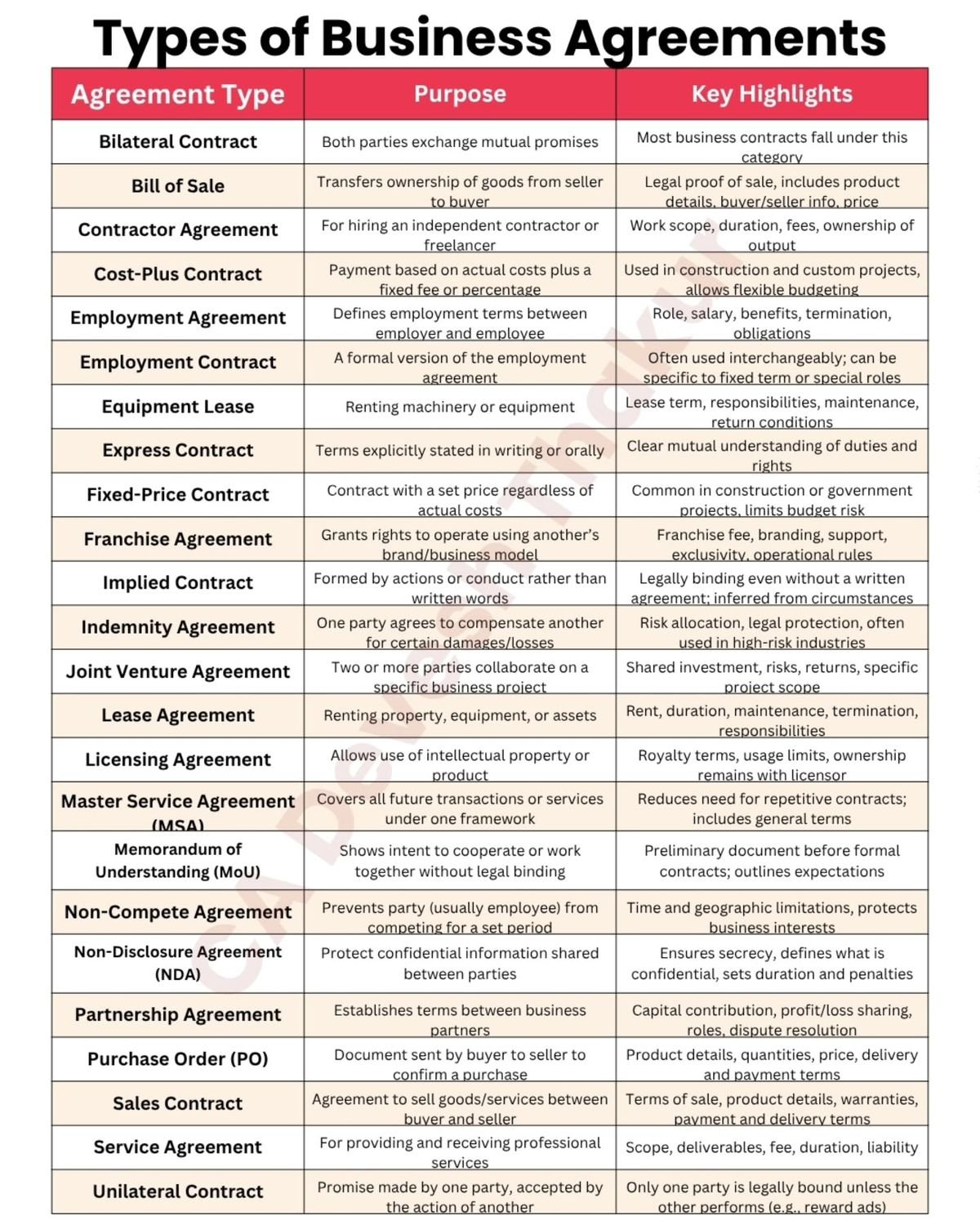
- Use Contract for enforceable deals with specific clients.
- Use Agreement for the broader concept of mutual understanding (often used in titles like "Terms of Agreement").
- Use Policy to declare your internal rules to the world (Privacy Policy, Acceptable Use Policy).
- Use Notice for warnings and formal communications.
- Use Statement for declarations of fact.
How They Work Together: A Practical Example for Your Website
- Step 1: The Notice & Policy. A new user visits your consulting website. They see a banner: "Notice: We have updated our Privacy Policy and Terms of Use." This notifies them of the changes.
- Step 2: The Policy. They click through to read your Privacy Policy. This is a policy that explains your one-way rules on data handling.
- Step 3: The Agreement. They decide to contact you via a form. Before submitting, they must check a box that says "I agree to the Terms of Use and Privacy Policy." By checking the box, they are entering into an agreement with you.
- Step 4: The Contract. The Terms of Use (the agreement) contain clauses that form a legally binding contract, such as payment terms, intellectual property rules, and limitations of liability.
- Step 5: The Statement. Within the Terms of Use, there is a statement: "We do not guarantee 100% uptime for our website." This is a declarative fact setting expectations.
1. Agreement
- Core Meaning: A broader term for any mutual understanding between two or more parties about their rights and responsibilities. It can be written, oral, or implied by conduct.
- Key Characteristic: Focuses on the "meeting of the minds" – the fact that all parties have consented to the same thing.
- Enforceability: Can be enforceable, but proving the terms of an oral agreement is difficult.
- Common Examples:
- A handshake deal.
- An email chain where terms are negotiated and agreed upon.
- The overarching "Master Services Agreement (MSA)" between two companies.
- "Terms of Use" or "Terms of Service" are technically agreements (you agree to them by using the site).
2. Contract
- Core Meaning: A specific type of agreement that is legally enforceable. A contract must contain certain elements: offer, acceptance, consideration (something of value exchanged), capacity, and legality.
- Key Characteristic: Enforceability in a court of law. If a party breaches a contract, the other party can sue for damages.
- Relationship to "Agreement": All contracts are agreements, but not all agreements are contracts. A contract is a formalized, enforceable agreement.
- Common Examples:
- A signed Client Contract for your consulting services.
- A Software Licensing Agreement.
- An Employment Contract.
- A clickwrap Terms of Service that includes a payment obligation forms a contract.
3. Policy
- Core Meaning: A set of rules, principles, or guidelines that govern how an organization operates or makes decisions. It is typically a one-way declaration from you to the world or your users.
- Key Characteristic: It states your rules and how you will behave. It is not inherently a negotiation between parties.
- Enforceability: Can become legally binding if it is incorporated into a contract or if a user's continued use of a service is conditioned on accepting the policy.
- Common Examples:
- Privacy Policy: Informs users how you collect, use, and share their data. (Required by law in many jurisdictions).
- Return Policy: States the rules for returning products to a store.
- Internal HR Policies: Rules for employees (which are often incorporated into the employment contract).
4. Notice
- Core Meaning: A formal communication or announcement intended to inform a party of a fact, claim, right, or potential action. Its primary purpose is disclosure and warning.
- Key Characteristic: It is informative, not (usually) negotiable. It is meant to make something known to avoid future legal claims (e.g., "you were warned").
- Enforceability: Not directly enforceable itself, but failure to provide a legally required notice can lead to penalties or prevent you from enforcing your rights.
- Common Examples:
- Copyright Notice: "© 2024 My Company LLC. All Rights Reserved." (A warning against infringement).
- Terms Update Notice: "We have updated our Privacy Policy. Click here to review."
- DMCA Takedown Notice: A formal request to remove copyrighted material.
- A sign that says "Not Responsible for Lost or Stolen Items."
5. Statement
- Core Meaning: A formal declaration of fact. It is often a subset of another document, like a policy or notice.
- Key Characteristic: Declarative. It states something as true.
- Enforceability: If a statement is false and someone relies on it to their detriment, it can lead to claims of misrepresentation or fraud.
- Common Examples:
- Privacy Statement: Often used interchangeably with "Privacy Policy," though sometimes it denotes a shorter summary.
- Mission Statement: Declares a company's purpose.
- Financial Statement: Declares financial facts.
- Warranty Statement: A declaration within a contract about the condition or functionality of a product.
without terms and conditions, it's harder to control disputes, making it harder protect you website. analytics data is still collected on static websites. EU / California laws. limitation of liabilities. accesibility compliance
academic/non-profits
- privacy policy
- terms of use
- copyright notice
- protect IP, name of copyright holder
- disclaimers about accuracy of the content
- manage expectations about information cant guarantee it's free from errors, or outdated
- for informational purposes only (for educational sites)
- accessbility - commitment to inclusivity
- contact info
Table of Contents
- legal considerations for entrepreneurs
- [nj one party consent recording](#nj one party consent recording)
- Clauses
- [Shareholders Agreement]
Terms and Conditions
- acceptance of terms
- modifications of terms
- user responsibilities
- acceptable behavior
- IP
- limitation of liability
- dispute resolution
- termination of accounts
- user conduct
- limitations
what legal agreements should an llc for-profit business website (that is a simple blog with lead generation contact form) have in order to guard itself from liability?
1. Terms of Service (TOS): This outlines the rules and expectations for users interacting with your client's website. A TOS can cover things like:
- Acceptable Use: Defining what kind of behavior is allowed on the website (e.g., no spamming, no copyright infringement).
- Limitations of Liability: Limiting your client's legal responsibility for any damages users experience while using the website (this should be done in consultation with a lawyer).
- Dispute Resolution: Outlining how any disagreements between users and the website will be handled.
2. Privacy Policy: This explains how your client's website collects, uses, and discloses user information. A privacy policy is required by law in some regions, and good practice everywhere. Here are some elements to include:
-
What information is collected: This could include contact information submitted through the form, cookies used for tracking purposes, etc.
-
How information is used: Explain how the information will be used to generate leads and contact potential clients.
-
User choices: Outline how users can control their information (e.g., opting out of email lists).
-
Intellectual Property: If your client has any unique content (written content, logos, images), consider obtaining copyright or trademark protection.
-
Third-Party Services: If the website uses any third-party services (e.g., contact form plugin), review their terms of service to understand any potential liabilities.
as a web designer for local small businesses, am i supposed to check a client's paperwork for legitimacy? such as llc registration, or proper industry-specific criteria like licensing and insurance policy?
No, as a web designer for local small businesses, you typically wouldn't be expected to verify the legitimacy of a client's paperwork. Here's why:
- Expertise: Verifying legal documents and licenses requires specific legal knowledge. It's not part of a web designer's skillset.
- Liability: If something were wrong with the paperwork and you missed it, you could be held liable.
However, there are some things you can do to protect yourself:
- Request basic information: It's reasonable to ask for the client's business name and contact information.
- Point them to resources: If the project requires specific licenses or permits, you can suggest they check with their local government or industry associations for requirements.
- Use a contract: A well-written contract will outline the scope of your work and protect you in case of any issues. Include clauses about payment terms, project revisions, and termination. There are many online resources for freelance contracts, but consider consulting a lawyer for a contract specific to your needs.
Here are some resources that might be helpful for your clients:
- U.S. Small Business Administration (SBA): https://www.sba.gov/
- SCORE: https://www.score.org/ - Offers free mentoring and resources for small businesses.
By focusing on your web design expertise and using clear communication, you can build successful relationships with your clients without getting involved in legal verification.
There are several convenient and affordable websites offering business and personal background checks. Here are a few options to consider, keeping in mind it's always wise to check their terms of service and specific packages offered:
if the contractor will have access to sensitive data, a more thorough background check may be warranted
For Business Background Checks:
- Checkr: Checkr background check offers tiered plans with varying levels of screening, including criminal records, employment verification, and education verification.
- TransUnion SmartMove: TransUnion SmartMove background check provides different packages with options for criminal background checks, credit reports, and eviction history.
For Personal Background Checks (on Yourself):
- TruthFinder: TruthFinder background check allows you to search for public records about yourself, including criminal records, addresses, and relatives.
- BeenVerified: [BeenVerified background check]([BeenVerified background check]) offers similar services to TruthFinder, with options for more in-depth reports.
General Considerations:
- Affordability: Prices can vary depending on the level of detail and the number of reports you need. Be sure to compare pricing before making a decision.
- Accuracy: Background check information comes from public records, so there's always a chance it might be incomplete or inaccurate. Consider the source and credibility of the information provided.
- Fair Credit Reporting Act (FCRA): There are legal regulations around conducting background checks, especially for employment purposes. Ensure the website you choose complies with the FCRA.
business ventures
example text found elsewhere, changed to have our brand names
BUILD then MARKET LLC is among the official legal entites associated with CANyouFLOW
Prior to a 2019 company reorganization, BUILD then MARKET was the parent company of Ambitious Royalty and also encompassed other retail ventures including SavageCEOs.com, BluntMamba.com, and TerpeneTandoori.com.
- Docusign
- Hellosign
legal considerations for entrepreneurs
- contract drafting
- intellectual property protection
- web development regulations
- representation in case of disputes
Business name
Choosing a business name that is unique and not already in use by another business is important. Entrepreneurs should also ensure that their chosen name does not infringe on any existing trademarks.
Business licenses and permits
Depending on the industry and location, businesses may require various permits and licenses to operate legally. It is important to research and obtain all necessary licenses and permits before starting operations.
Obtain necessary permits or licenses
Depending on the type of business and the location where you are operating, you may need to obtain permits or licenses from local or state authorities before you can legally conduct business from your home.
Comply with zoning laws
Make sure that your home-based business is allowed under local zoning laws. Some areas have restrictions on the types of businesses that can be operated from a residential property.
Follow telemarketing laws
If you are conducting business by phone, you must comply with telemarketing laws, such as the Telephone Consumer Protection Act. This includes obtaining consent from individuals before making calls, honoring do-not-call lists, and providing opt-out options.
Follow spam laws
If you are conducting business by email or other electronic means, you must comply with spam laws, such as the CAN-SPAM Act. This includes obtaining consent from individuals before sending emails, providing an opt-out option, and including accurate and truthful information in the email.
Follow privacy laws
Make sure that you are handling personal information in accordance with applicable privacy laws, such as the General Data Protection Regulation (GDPR) if you are conducting business with customers in the European Union.
Follow tax laws
Make sure that you are complying with all applicable tax laws, including registering for any necessary tax identification numbers and filing tax returns.
Overall, it is important to ensure that you are operating your at-home business in a legal and ethical manner. This includes complying with applicable laws and regulations, obtaining necessary permits and licenses, and handling personal information and taxes appropriately.
Free Clinic
- Gramm Leach Bliley Act
- HIPAA
- HITECH Act
- PCI DSS
- FISMA
- State Protection & Notification Laws
- Procurement Management
- [Hiring]
Procurement
Scope of Services Clause Services includes regular meetings using email discussions, phone calls, AND video conferencing, project planning, BUILD then MARKET’s client’s software development, feedback, and change requests. Completion of project needs is subject to change with ongoing software product pivots that will lead to changes in scope.
Topics
- introductory period
- Standards of Conduct
- dress code
- Equal Opportunity & Americans with Disabilities Act
- Data Security and Customer Privacy
Contributor Code of Conduct
Version 0.1
As contributors and maintainers of the BUILD then MARKET project, we pledge to respect everyone who contributes by posting issues, updating documentation, submitting pull requests, providing feedback in comments, and any other activities.
Communication through any of BUILD then MARKET's channels (GitHub, Gitter, IRC, mailing lists, Google+, Twitter, etc.) must be constructive and never resort to personal attacks, trolling, public or private harassment, insults, or other unprofessional conduct.
We promise to extend courtesy and respect to everyone involved in this project regardless of gender, gender identity, sexual orientation, disability, age, race, ethnicity, religion, or level of experience. We expect anyone contributing to the BUILD then MARKET project to do the same.
If any member of the community violates this code of conduct, the maintainers of the BUILD then MARKET project may take action, removing issues, comments, and PRs or blocking accounts as deemed appropriate.
If you are subject to or witness unacceptable behavior, or have any other concerns, please email us at contact@buildthenmarket.com.
Third Party License
Third Party License means a license from an unaffiliated third party to one or more valid and enforceable patents issued in the United States or any other jurisdiction, the claims of which cover one or more functional components that is essential for the efficacy of the Licensed Product.
example contract clauses
Return or Destruction Clause
Open Source Software Citations
Section 4.14(p) of the Disclosure Schedule lists all software that is distributed as “open source software” or under a similar licensing or distribution model (including but not limited to the GNU General Public License (GPL), GNU Lesser General Public License (LGPL), Mozilla Public License (MPL), BSD licenses, the Artistic License, the Netscape Public License, the Sun Community Source License (SCSL), the Sun Industry Standards License (SISL) and the Apache License) (collectively, “Open Source Software”) that has been incorporated into, linked with, distributed with or used in the development of any Company Product in any way and describes the manner in which such Open Source Software was incorporated, linked or otherwise used (such description shall include, without limitation, whether (and, if so, how) the Open Source Software was modified and/or distributed by the Company and whether (and if so, how) such Open Source Software was incorporated into or linked in any Company Product). Except as set forth in Section 4.14(p)(2) of the Disclosure Schedule, neither the Company nor any of its Subsidiaries has used Open Source Software in any manner that (i) requires the disclosure or distribution in source code form of any Technology owned by the Company or any of its Subsidiaries, or any portion of any Company Product other than such Open Source Software, (ii) requires the licensing of any Technology owned by the Company or any of its Subsidiaries, or any portion of any Company Product other than such Open Source Software, for the purpose of making derivative works, (iii) imposes any restriction on the consideration to be charged for the distribution of any Company Product or any Technology owned by the Company or any of its Subsidiaries, (iv) creates obligations for the Company or any of its Subsidiaries with respect to Company Intellectual Property or grants to any third party, any rights or immunities under Company Intellectual Property, or (v) impose any other limitation, restriction or condition on the right of the Company to use or distribute and Company Product. With respect to any Open Source Software that is used by the Company or any of its Subsidiaries in the operation of its business, the Company and each of its Subsidiaries is in compliance with all applicable licenses with respect thereto, complete copies of which have been provided to Parent.
assignment/subcontracting
- the employee does not have the right to assign or subcontract any of its obligations or duties under this agreement, without the prior written consent of the company
Cumulative Rights
-
Any specific right or remedy provided in this contract will not be exclusive but will be cumulative of all other rights and remedies.
-
political neutrality
Websites: domain names cannot be copyrighted.
Restrictive Covenants
A. Legitimate Business Interests: The Parties recognize and agree that the Parties have legitimate interests in protecting their business from unfair solicitation of each other’s clients, prospective clients and employees, in protecting its Confidential Information and that of each other’s clients, and in protecting any investment in training an Employee and from any other conduct that could unfairly harm business (“Legitimate Business Interests”).
B. Confidentiality: The Parties agree either during the term of this Agreement or at any time following the termination of this Agreement, not to directly or indirectly disclose to any person, firm, corporation or enterprise any Confidential Information belonging to the Parties and their clients. The Parties must agree to inform each other of any such disclosure of Confidential Information, and to disclose any unauthorized use that an Employee or any other person or entity has made of any Confidential Information. Both Parties must adhere to data security standards with highly sensitive customer, employee, or other third-party information. Neither Party can disclose confidential or personal information to any outside or third parties.
Choice of Venue / Choice of Governing Law
what state/country laws will apply?
-
This agreement shall be governed by and construed in accordance with the internal laws of the State of XXX, U.S.A., without reference to any conflicts of law provisions.
-
Each party hereby submits to the exclusive jurisdiction of, and waives any venue or other objection against, any federal court sitting in the State of XXX, U.S.A., or any XXX state court in any legal proceeding arising out of or relating to this contract. Each party agrees that all claims and matters may be heard and determined in any such court and each party waives any right to object to such filing on venue, forum non-convenient, or similar grounds.
Brand Assets
my savage ceos logo available for download on a logos website without asking my permission
Legal Clinics
https://law.rutgers.edu/legal-clinics
Attorney referral services Middlesex county bar association 87 bayard st
732 828 0053 ext 100
https://law.rutgers.edu/legal-assistance
policies procedures employee relations contracts pending litigation
Trolls
Crawling permitted in TOC
facebook harvestor lawsuit?
Clauses
Attorney's Fees
- The non-prevailing party in any dispute under this agreement shall pay all costs and expenses, including expert witness fees and attorneys' fees, incurred by the prevailing party in resolving such dispute.
ACKNOWLEDGMENT OF RECEIPT OF HANDBOOK
This will acknowledge that I have received my copy of the Company Employee Handbook and that I will familiarize myself with its contents.
I understand that this handbook represents the current policies, regulations, and benefits and that except for employment at-will status and the Arbitration Agreement, any and all policies or practices can be changed at any time by the Company. The Company retains the right to add, change, or delete wages, benefits, policies, and all other working conditions at any time (except the policy of “at-will employment” and Arbitration Agreement, which may not be changed, altered, revised, or modified without a writing signed by the President).
I further understand that nothing in the Employee Handbook creates or is intended to create a promise or representation of continued employment and that my employment, position, and compensation at the Company are “at-will”, and may be changed or terminated at the will of the Company. I understand that I have the right to terminate my employment at any time, with or without cause or notice, and that the Company has a similar right. My signature below certifies that I understand the foregoing agreement and that at-will status is the sole and entire agreement between the Company and me concerning the duration of my employment and the circumstances under which my employment may be terminated. It supersedes all prior agreements, understandings, and representations (whether written or oral) concerning my employment with the Company.
Compliance with Laws
- Each party shall comply in all respects with all applicable legal requirements governing the duties, obligations, and business practices of that party and shall obtain any permits or licenses necessary for its operations. Neither party shall take any action in violation of any applicable legal requirement that could result in liability being imposed on the other party.
Time Entry Affadavit
I affirm that all information entered into the time-keeping system is accurate, complete, and correct, and has been entered under the correct job number. I understand that it is my responsibility to record my time in an accurate and timely manner and promptly correct any errors.
Timesheet TO THE EMPLOYEE: Please read carefully. If you require translation, by electronically submitting this timesheet you acknowledge that this form has been read to you in your native language or otherwise translated, and that you understand completely the contents of this form.
By submitting my timesheet, I acknowledge that:
- I understand that it is my responsibility to accurately record my time worked, including compensable travel time, and to promptly review each of my paychecks when received to insure that it accurately reflects my wages for all hours I actually worked. By submitting this timesheet, I agree that all hours and expenses entered are correct and accurate to the best of my knowledge. Prior Client approval is required for all overtime (any W2 employee in California working more than 8 hours per day and/or 40 hours per week; any W2 employee outside of California working more than 40 hours per week). In addition, all expenses need prior written Client approval and itemized receipts in order to be reimbursed.
- I understand that the Company's policy requires me to promptly clock in and clock out when I begin and end my work shift, including before and after my unpaid meal period(s).
- | further understand that I am entitled to meal and rest periods, in accordance with applicable law. I understand it is my responsibility to notify my supervisor in writing, each time I believe I was not provided with a required meal or rest period. If I do not submit notification of an issue, the Company should assume that I was properly provided with such meal and rest periods.
- I understand that I must report any errors in my time records and/or my pay either to my Account Manager or to the Company's Human Resources Department.
- If I believe that my paycheck is not correct or hours worked are not accurately reflected, I will immediately notify my Account Manager and/or Human Resources and provide a specific explanation in writing so that the Company may promptly address the issue.
Identity Verification You must be able to verify some information about yourself and:
- Have a valid email address;
- Have a Social Security number;
- Have a U.S. mailing address; and
- Be at least 18 years of age.
When you make a verification request to establish your account, our Identity Services Provider may use information from your credit report to help verify your identity. As a result, you may see a “soft” inquiry entry on your credit report with the Identity Services Provider, indicating that the Social Security Administration made an inquiry at your request and the date of that request. Soft inquiries do not affect your credit score, and you do not incur any charges related to them. Soft inquiries are displayed in the version of the credit report provided to a consumer and are not reported to lenders. Soft inquiries will not appear on your credit report from other providers. Soft inquiries are generally removed from your credit report after 12 months. Once you have registered for an online account, you will not generate additional soft inquiries by logging in to access our services.
soliciting business
When it comes to soliciting business or contributions, there are several legal guidelines that individuals and organizations must follow to avoid violating laws and regulations. Here are some common legal guidelines for soliciting business or contributions:
-
Obtain necessary permits or licenses: Depending on the type of business or organization and the location where they are operating, they may need to obtain permits or licenses from local or state authorities before they can legally solicit business or contributions.
-
Avoid deceptive practices: It is important to avoid any deceptive or misleading practices when soliciting business or contributions. This includes making false or exaggerated claims, misrepresenting the purpose of the solicitation, or withholding important information from potential customers or donors.
-
Comply with telemarketing laws: If soliciting business or contributions over the phone, it is important to comply with telemarketing laws, such as the Telephone Consumer Protection Act. This includes obtaining consent from individuals before making calls, honoring do-not-call lists, and providing opt-out options.
-
Comply with spam laws: If soliciting business or contributions through email or other electronic means, it is important to comply with spam laws, such as the CAN-SPAM Act. This includes obtaining consent from individuals before sending emails, providing an opt-out option, and including accurate and truthful information in the email.
-
Comply with charity laws: If soliciting contributions for a charitable organization, it is important to comply with charity laws, such as registering with state authorities and providing accurate and truthful information about the organization's purpose and activities.
Overall, it is important to ensure that any solicitation of business or contributions is conducted in a legal and ethical manner. This includes complying with applicable laws and regulations, avoiding deceptive practices, and providing accurate and truthful information to potential customers or donors.
[[index]]