SMLLC Operating Agreement
This covers the internal structure and management of the company, including ownership, responsibilities, and decision-making processes.

Business Purpose: The operating agreement should specify the purpose of the business, including the goods or services that will be offered.
Ownership: The operating agreement should identify the owner of the LLC and specify the ownership percentage. It should also outline the process for transferring ownership in the event of the owner's death or incapacity.
Management: The operating agreement should specify who will manage the day-to-day operations of the business. For a single member LLC, the owner typically serves as the manager.
Capital Contributions: The operating agreement should specify the amount of capital the owner will contribute to the business, as well as any additional contributions that may be required.
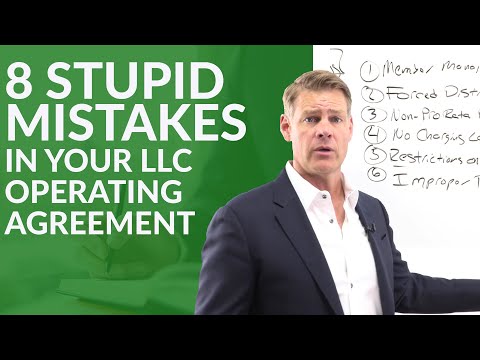
- forced distributions
- Non-Pro Rata Distributions
Profits and Losses: The operating agreement should outline how profits and losses will be allocated among the owner and any other members of the LLC.
Voting Rights: The operating agreement should specify the voting rights of the owner, including the number of votes required to make decisions and the process for voting.
Dissolution: The operating agreement should outline the process for dissolving the LLC, including how assets will be distributed and how outstanding debts will be paid.
Amendments: The operating agreement should specify how it can be amended or revised, including the process for making changes and the required vote or consent.
Prepare Operating Agreement
- While it is not typically required by law to have an operating agreement for a single member LLC, it is still a good idea to have one in place to help protect the owner's personal assets and to establish clear guidelines for how the business will operate.
- Operating agreements are generally between five and twenty pages long.
To protect the business' limited liability status: Operating agreements give members protection from personal liability to the LLC. Without this specific formality, your LLC can closely resemble a sole proprietorship or partnership, jeopardizing your personal liability.
To clarify verbal agreements: Even if members have orally agreed to certain terms, misunderstanding or miscommunication can take place. It is always best to have the operational conditions and other business arrangements handled in writing so they can be referred to in the event of any conflict.
it outlines the business' financial and functional decisions including rules, regulations and provisions. The purpose of the document is to govern the internal operations of the business in a way that suits the specific needs of the business owners. Once the document is signed by the members of the limited liability company, it acts as an official contract binding them to its terms.
Personal Liability Protection
- because you want the liability protection
If you have business partners
"Members" of the LLC
the agreement amongst the LLC and with the LLC itself.
- describe how decisions will be made
- unanimous
- how members can take distributions
- how taxes will be allocated
- what happens if a member leaves
EIN Number
Amendments
- Specify a clear process for amending or revising the operating agreement, including:
- The required vote or consent of the owner (e.g., unanimous approval)
- A specific timeframe for submitting proposed amendments
- A mechanism for notifying all relevant parties (if applicable)
Management
- Clarify the role and responsibilities of the manager(s) in more detail, such as:
- Definition of "day-to-day operations" to avoid ambiguity
- Specific duties or powers granted to the manager(s)
- Mechanisms for decision-making and dispute resolution
Capital Contributions
- Specify additional details regarding capital contributions, including:
- The initial amount contributed by the owner (and any subsequent increases)
- Any restrictions on withdrawals or distributions of funds
- A clear process for handling forced distributions or non-pro rata distributions
Miscellaneous Provisions
- Consider adding provisions to address potential issues or scenarios that may arise, such as:
- Procedures for resolving disputes between the owner and third parties (e.g., clients, vendors)
- Guidelines for handling confidential information and intellectual property
- A clear process for dissolving the LLC in case of death or incapacitation
Review and Revision
- Schedule regular reviews of the operating agreement to ensure it remains relevant and effective. This can be done annually or bi-annually.
That is an excellent and crucial question. When implementing a nonqualified deferred compensation plan like a Phantom Equity Unit (PEU) or Phantom Stock Plan in a Single-Member LLC (SMLLC) for an Independent Contractor (IC), proper documentation is the backbone of IRS Section 409A compliance.
The general answer to your question is Yes, the equity plan should be a document separate from both the SMLLC Operating Agreement and the IC Agreement, though all three documents must reference each other for consistency.
Here is a breakdown of the required documentation structure for compliance:
📄 Required Documents for 409A Compliance
1. The Phantom Equity Plan Document (The Master Plan)
This is the foundational document that governs the entire arrangement. It must be a formal, written plan that is established before the legally binding right to the deferred compensation is created.
- SMLLC Adoption: Since an SMLLC does not have a "Board of Directors," this plan is formally adopted and approved by the Sole Member (you) in their capacity as the owner/manager.
- 409A Compliance Clause: Must contain explicit language that the plan is intended to comply with, or be exempt from, Section 409A and its regulations. It should clearly define all terms consistent with 409A (e.g., Separation from Service, Change in Control).
- The "Phantom" Concept: Defines the nature of the award (e.g., "Phantom Stock Unit" or "Phantom Equity Unit"), confirming it is an unfunded, unsecured contractual right to a cash payment, not actual equity/membership interest.
- Valuation Methodology: Specifies the objective, written formula or procedure for determining the Fair Market Value (FMV) of a notional unit at the time of grant and, most importantly, at the time of payout. For a private SMLLC, this is critical and must be consistent.
- Award Pool: Defines the maximum number of phantom units or the percentage of total company value reserved for this plan.
- Payment Events: Crucially, it must list the permissible, 409A-compliant payment triggers (e.g., fixed date, separation from service, death, disability, change in control) and the fixed time/schedule for payment following that event.
2. The Individual Independent Contractor (IC) Agreement
This is the primary contract between the SMLLC and the service provider.
- IC Status Confirmation: Explicitly confirms the recipient's status as an Independent Contractor (Service Provider) and not an employee, which impacts both 409A and payroll tax compliance.
- Reference to PEU Plan: The IC Agreement should clearly state that the IC is eligible to participate in the company's [Name of Phantom Equity Plan], but it should not contain the full details of the grant or vesting.
3. The Individual Phantom Unit Grant Agreement (The Award Agreement)
This document links the individual's grant to the Master Plan and is where the specific details for the IC are defined.
- Reference to Master Plan: Explicitly incorporates the terms and conditions of the Master PEU Plan.
- Grant Details:
- Number of Units: The specific number of phantom units granted to the IC.
- Vesting Schedule: Clearly defines the Individual Performance Milestones that cause the units to vest (become non-forfeitable).
- Payment Timing: Must reference the fixed payment event/date from the Master Plan. For instance: "Vested units shall be paid out on the Fixed Payout Date, which is defined in the Plan as January 31st of the year following the calendar year of vesting."
4. The SMLLC Operating Agreement (Governance Document)
While the PEU Plan is separate, the Operating Agreement is necessary to ensure internal consistency and legal validity.
- PEU Plan Authorization: The Operating Agreement should contain a provision authorizing the Sole Member to establish, adopt, and administer compensation or incentive plans, including those using phantom equity, for ICs and/or employees.
- Equity Definition/Distinction: It should clearly define the Membership Interests (actual equity) of the SMLLC and explicitly state that the Phantom Units granted under the separate PEU Plan do not constitute Membership Interests, voting rights, or capital contributions in the LLC. This protects the limited liability structure.
🚦 Why the Separation is Recommended
Keeping the documents separate is not strictly required by 409A, but it is highly recommended best practice for legal clarity, compliance, and administration:
| Document | Primary Purpose | Why it Should be Separate |
|---|---|---|
| PEU Master Plan | Governs the tax compliance (409A) and mechanics of the award. | Deals with complex, specific tax law. Keeps 409A definitions centralized and consistent for all participants (now and future). |
| IC Agreement | Governs the contractual relationship and scope of work. | Keeps the service relationship separate from the equity grant. Avoids having to re-draft 409A provisions every time the IC's scope changes. |
| Operating Agreement | Governs the internal governance, ownership, and economics of the SMLLC. | Protects the LLC's ownership structure and member liability. Keeps non-owner compensation out of the core governance document. |
In summary, for full compliance, you need a coordinated suite of documents: the Operating Agreement authorizes the plan, the PEU Master Plan defines the 409A-compliant rules, and the IC Agreement and Grant Agreement apply those rules to the individual contractor.
Would you like me to find more information on the specific 409A definitions that must be included in your Master Plan (like "Change in Control" or "Disability")?