AI Perils
Loops
- getting stuck in a context loop
- failure loop
read the error logs carefully
Quotes
- If you don’t know why the code works, you definitely won’t know why it fails.
- execution difficulty remains constant despite AI capabilities
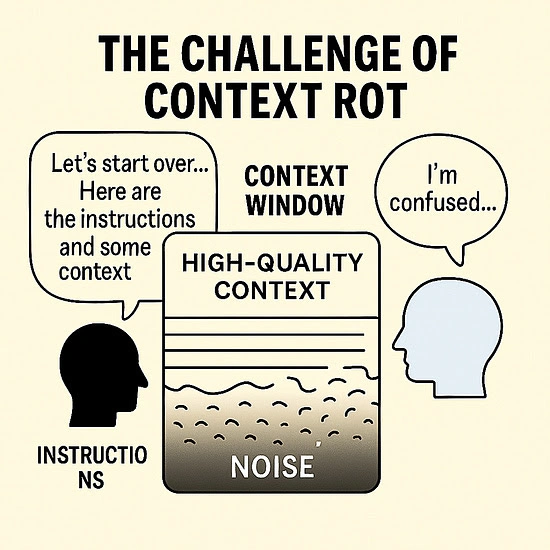
The challenge of context rot
As we get better at assembling rich context, we run into a new problem: context can actually poison itself over time. This phenomenon, aptly termed "context rot" by developer Workaccount2 on Hacker News, describes how context quality degrades as conversations grow longer and accumulate distractions, dead ends, and low-quality information.
Subtle signs your skills are atrophying
It's not just hypothetical - there are telltale signs that reliance on AI might be eroding your craftsmanship in software development:
-
Debugging despair: Are you skipping the debugger and going straight to AI for every exception? If reading a stacktrace or stepping through code feels arduous now, keep an eye on this skill. In the pre-AI days, wrestling with a bug was a learning crucible; now it's tempting to offload that effort. One developer admitted he no longer even reads error messages fully - he just sends them to the AI. The result: when the AI isn't available or stumped, he's at a loss on how to diagnose issues the old-fashioned way.
-
Blind Copy-Paste coding: It's fine to have AI write boilerplate, but do you understand why the code it gave you works? If you find yourself pasting in code that you couldn't implement or explain on your own, be careful. Young devs especially report shipping code faster than ever with AI, yet when asked why a certain solution is chosen or how it handles edge cases, they draw blanks. The foundational knowledge that comes from struggling through alternatives is just... missing.
-
Architecture and big-picture thinking: Complex system design can't be solved by a single prompt. If you've grown accustomed to solving bite-sized problems with AI, you might notice a reluctance to tackle higher-level architectural planning without it. The AI can suggest design patterns or schemas, but it won't grasp the full context of your unique system. Over-reliance might mean you haven't practiced piecing components together mentally. For instance, you might accept an AI-suggested component without considering how it fits into the broader performance, security, or maintainability picture - something experienced engineers do via hard-earned intuition. If those system-level thinking muscles aren't flexed, they can weaken.
-
Diminished memory & recall: Are basic API calls or language idioms slipping from your memory? It's normal to forget rarely-used details, but if everyday syntax or concepts now escape you because the AI autocomplete always fills it in, you might be experiencing skill fade. You don't want to become the equivalent of a calculator-dependent student who's forgotten how to do arithmetic by hand.