Wireframing & Prototyping
- KISS (Keep it simple)
- Get users to the app's "Magic Moment" as fast as possible
- be ruthless with what feature you actually need for the MVP. watch out for feature creep
- sanity check user flow internally before demoing to client
Optical Alignment in UX Design
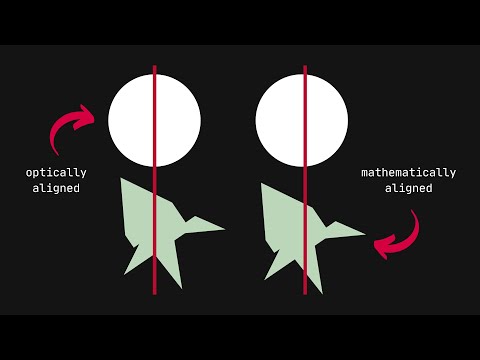
In UX design, optical alignment refers to the visual perception of how elements are positioned on a screen. It's about creating a sense of balance and order that feels natural and intuitive to the human eye, even if it might not perfectly align with mathematical precision.
Key Concepts:
- Human Perception: Our eyes don't perceive space and distance perfectly linearly.
- Visual Weight: Different shapes and elements have varying visual weights. For instance, a bold headline carries more weight than a thin line.
- Subtle Adjustments: Optical alignment often involves making slight adjustments to spacing or positioning to achieve a visually balanced composition.
Why is it Important in UX?
- Improved Readability: Proper alignment, especially for text, enhances readability and reduces eye strain.
- Enhanced Aesthetics: Visually pleasing layouts create a more professional and polished look, which can increase user trust and engagement.
- Better User Experience: A well-aligned interface feels more intuitive and easier to navigate, leading to a more positive user experience.
Examples:
- Text Alignment: Left-aligning text is generally considered most readable, but slight adjustments might be needed to compensate for the visual weight of punctuation.
- Image Placement: Aligning images with the edges of containers or other elements can create a more visually stable composition.
- Spacing: Adjusting spacing between elements can significantly impact the perceived balance and visual flow of the interface.
Tools and Techniques:
- Grid Systems: Using a grid system can provide a framework for consistent and visually balanced layouts.
- Design Software: Tools like Figma, Sketch, and Adobe XD offer features like guides and rulers to help with precise alignment.
- Prototyping and Testing: Testing designs with users can provide valuable feedback on the perceived balance and usability of the interface.
In essence, optical alignment is about creating a visually harmonious and user-friendly experience by understanding how the human eye perceives and interacts with design elements.
Rapid Prototyping
- PoC - Proof-of-Concept
- MVP - Minimum Viable Product
Creating a prototype for UI (User Interface) in application design can bring several benefits. Overall, creating a prototype for UI in application design can help designers create more effective and user-friendly designs. By incorporating user feedback, reducing costs, improving communication, enabling iterative design,providing a visual representation, and supporting user testing, prototypes can help ensure that the final design meets the needs of the target audience and results in a successful product.
User feedback: Prototyping allows designers to get user feedback early in the design process. This feedback can be used to improve the design, catch potential usability issues, and ensure that the design meets the needs of the target audience.
Cost savings: Prototyping can help reduce costs associated with making changes later in the design process. By catching issues early, designers can avoid costly revisions and rework down the line.
Improved communication: Prototypes can help designers communicate their design ideas more effectively to stakeholders and team members. This can lead to better collaboration and a more cohesive design process.
Iterative design: Prototyping allows designers to iterate on their designs quickly and easily. By creating multiple versions of the prototype, designers can test different design solutions and refine the design until it meets the needs of the target audience.
Visual representation: Prototypes provide a visual representation of the design, making it easier for stakeholders and team members to understand the design concepts and how they will work in practice.
User testing: Prototypes can be used for user testing to validate design assumptions and ensure that the design meets the needs of the target audience. User testing can help identify usability issues and inform design decisions.
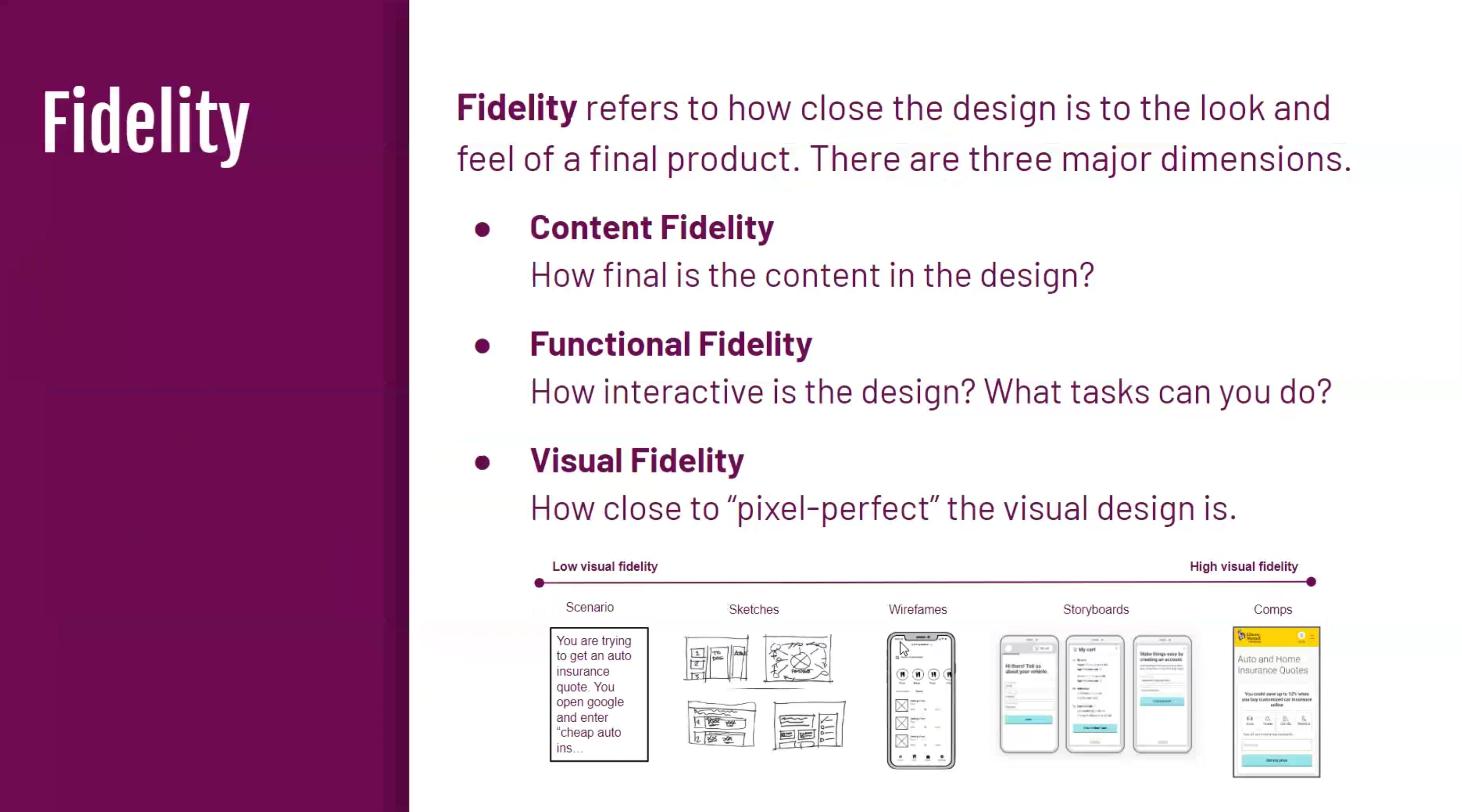
| Prototype Terms | definition |
|---|---|
| "gray screen" prototype | no visuals, avg 1.75 months |
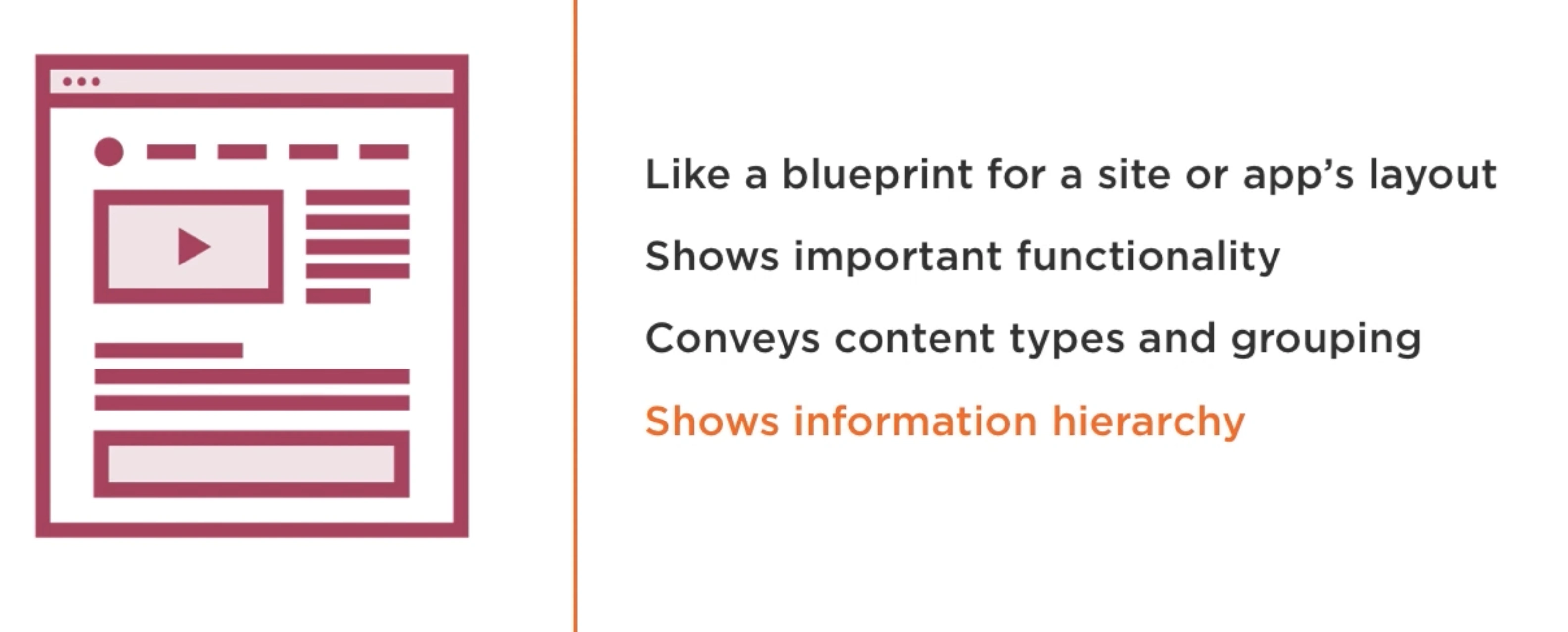
| Wireframes | are basic, black and white renderings that focus on what the new product or feature will do. |
| Mockups | are static yet realistic renderings of what a product or feature will look like and how it will be used. |
| Prototypes | are high-fidelity representations that demonstrate how a user will interact with the new product or feature. |
| Prototype | Description |
|---|---|
| purpose: | to verify if there’s an interest in your product (think of a car prototype exhibited at a car shows, tested on tracks) |
| target audience: | innovators, early adopters |
| goal: | verifying if your target audience using your product get the success that you promise to deliver |
| key activities: | user onboarding, customer success, customer interviews, UX measuring, user observation, highly targeted customer acquisition, first sales |
| success criteria:** | meeting specific KPIs by your customers for defined usecases, conversion rates for user acquisition (f.e.: from demo -> paid, from landing-page to registration, from registration to activation), getting case-studies with success stories |
| how to get there:** | focus on onboarding users and making sure you overdeliver, gather feedback and act on it, identify niches and customer segments that are most successful |
| budget: | $250k-$2M (Pre-Seed/Seed/Business Angel) |
| Fundraising: | business angels, pre-seed/seed capital/ microVCs/crownfunding |
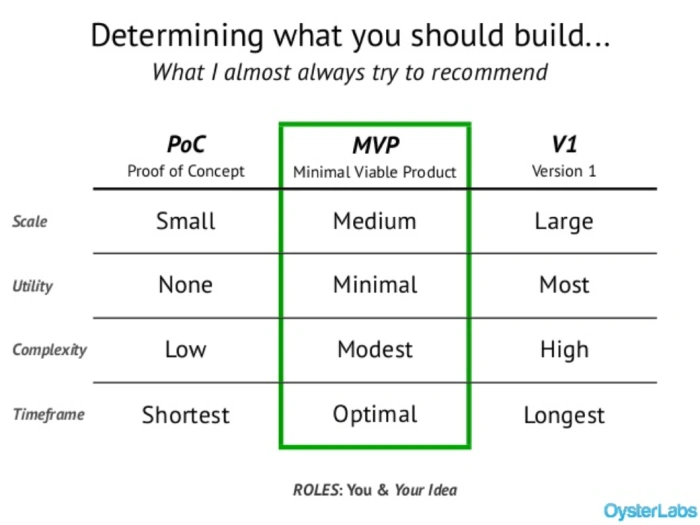
| PoC - Proof-of-Concept | Description | | |---------|---------| | | purpose:** | to prove that you are capable of solving a problem 10x better (think of a PoC as of the improvements that automotive tests on F1 track, like KERS before we had it in our cars to recharge batteries while breaking or sketches and visualisations of a car that will be there in 5 years) | | target audience:** | experts, journalists, innovators (see the law of innovation diffusion) within your target group | | goal: | verifying if your solution is good enough to impact change in your target market so they switch from whatever they do to solve it right now to what you have created | | key activities: | gathering feedback - customer interviews, UX measuring (google analytics), user observation (hotjar) | | success criteria: | testimonials saying “yes it’s 10x better than what I’m doing now, I will be interested in paying X USD/month to use it”, meeting specific KPIs by your customers for defined usecases | | how to get there: | iterate on feedback until meeting success criteria | | budget: $5k-$250k (business angel | | Fundraising:** | own capital, family friends & fools, business angels, incubators |
| MVP - Minimum Viable Product | Description |
|---|---|
| purpose: | crossing the chasm between early adopters and early majority |
| target audience: | early majority |
| **goal: | for SaaS it’s growing fast enough (f.e. 10% MoM before you hit $1M ARR) and getting to estimated Customer Lifetime Value = 4* Customer Acquisition Cost |
| **key activities: | marketing automation, PR, measurements, UX improvements, automated onboarding, optimising your product for the most successful niche/customer segment, content marketing, social media monitoring, building your own tech team |
| **success criteria: | growth rate (differs much on what’s your pricing, volume, time-to-deal), CAC, LTV, Churn, MRR, ARR, ARPU |
| how to get there: | focus on the niche/customer segment that is most successful with your product, build success stories that you can communicate to massive market, automate whatever you canet |
| **budget: | $5-$10M (Series A) |
| Fundraising: | VC |
| FFP - Fully Featured Product | Description |
|---|---|
| purpose: | scaling up, increasing market share |
| target audience: | early majority, late majority, laggards |
| goal: | exit or sustainability, increasing LTV, decreasing Churn, entering new markets (geographic, verticals, niches) |
| key activities: | building new features, adopting the solution to new use cases/niches/customer segments, improving pricing |
| success criteria: | valuation on exit, income, revenue |
| how to get there: | focus on new features that your users want to pay for, identify and conquer new markets, build new product lines, enable tool customisation, integrate with other tools, automate flows, introduce premium services, move up-the-market |
| budget: | $15M+ (series B) |
| Fundraising: | VCs, Private Equity (usually much higher deals) |