Delegation
Delegation involves assigning tasks and responsibilities to others while retaining ultimate accountability. Here are some key principles for effective delegation:
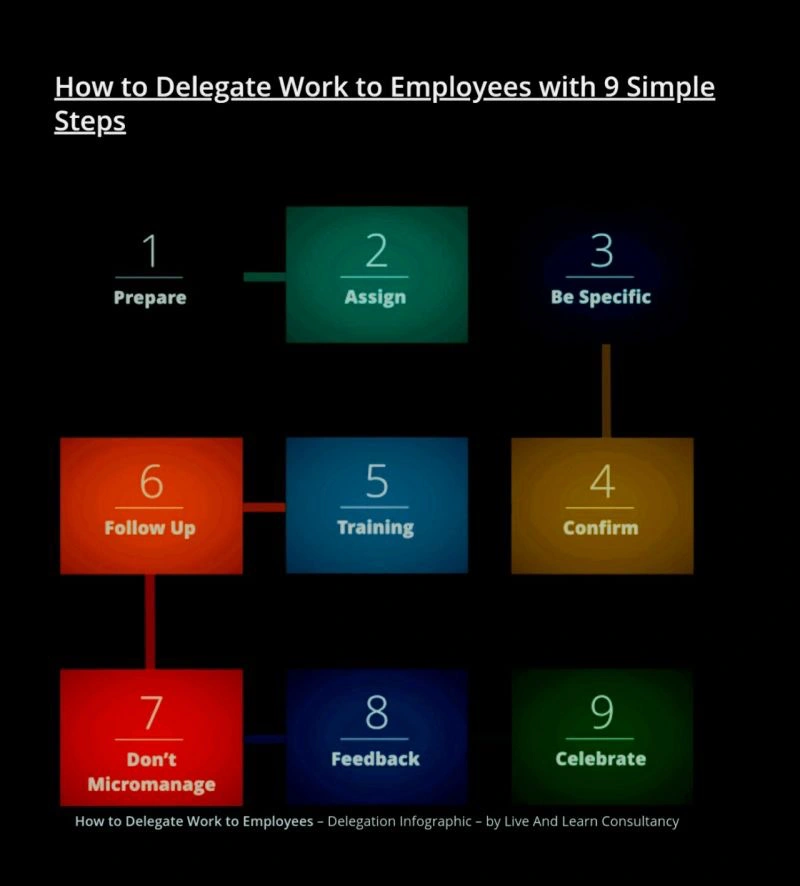
Clearly define expectations
Clearly communicate the desired outcome, deadlines, and any specific requirements for the delegated task. Ensure that the person taking on the task understands the goals and expectations.
Match skills and capabilities
Delegate tasks to individuals who have the necessary skills, knowledge, and experience to handle them effectively. Consider their strengths and development areas to ensure a successful outcome.
Provide support and resources
Offer the necessary support, guidance, and resources to enable success. Be available for questions, provide feedback, and remove any obstacles that may hinder progress.
Foster autonomy
Delegate authority along with responsibility. Encourage individuals to make decisions within their delegated tasks and provide them with the freedom to explore different approaches.
Monitor progress and provide feedback
Regularly check in on the progress of delegated tasks. Provide constructive feedback, recognize achievements, and offer guidance as needed. This ensures accountability and allows for course correction if required.
By embracing agile decision-making, decentralized decision-making, and effective delegation, you can create a collaborative and empowered work environment that fosters innovation, accountability, and growth within your organization.
feeling like your team isn't fully owning their responsibilities?
This lack of accountability can hinder your business's growth and scalability. Building a culture where your team takes full ownership of their work is essential for success.
Step 1. Determine the task to delegate. It doesn't matter if it's in your personal or professional life, you should always be spending your time on only the most critical tasks. These could be the ones that matter the most, have the highest value, or are things only you can or like to do. Put a question mark on everything else, especially if it is a time-consuming or recurring task.
Step 2. Pick the right person for the job. Match the requirements of the job to the abilities of the person. Choose people based on the right skillset, don't just look for the ones that are easy or cheap. Also, consider whether it might be a job that could be accomplished using a standardized offering, such as a software service instead.
Step 3. Place your trust in people. Delegate the entire job, not only parts of it. This will also transfer the feeling of actual ownership which is a key motivator to perform. Furthermore, match the amount of responsibility with the amount of authority that should naturally come with the delegation. You can also see delegation as a means of growing and developing others or giving them a chance to prove themselves, even if it might be a critical or confidential task.
Step 4. Provide a friendly and clear explanation. Begin with the end in mind and specify the expected and measurable results. You can provide directions, give an example of how you would solve the task or even train people, but refrain from restricting the way to the goal. Allowing the person to reach their way to the goal makes the task more inspiring to them. And if a task is less important, share what would be a "good enough" result or an adequate time and effort you would put in yourself.
Step 5. Make people understand the Why. Put the task into a broader context. Share the relevance of the task itself, reasons for doing it in the first place, and indicate its contribution to the overall goal or benefit of the company, team or individual. And on the other hand, what would be the negative impact of not doing things? Understanding the motivation behind a task can be key to get one's full buy-in.
Step 6. Provide the tools required. Establish the best possible conditions and give them the same chance you might have, e.g. approach them ahead of time or immediately after you hear of the task, forward relevant documents you might have received, or offer them a budget to work with on their own. Share existing boundaries and constraints, if any. Explain your support along the way, like offering help in providing more instructions or alignment when needed.
Step 7. Communicate expectations, follow-ups and consequences. Set a deadline, maybe with milestones leading to task completion, a buffer at the very end for possible adjustments, and a feedback and tweaking loop. Agree on a system to monitor progress and check the final result, but be patient if people do not yet have the same expertise as you might have. Never micromanage. Share emotional or financial consequences for them if the task does not get done right, on time, or at all. If you like, offer rewards they can expect upon successful completion.
Step 8. Confirm understanding and commitment. It is best to have them repeat or put in writing what they have understood in their words. Politely correct any misunderstandings, e.g. by rephrasing your initial briefing, "for the sake of clarity." This way you can make sure your delegation will succeed. Then, let people accept and do their job.
The Impact of a Lack of Accountability
-
You Become the Bottleneck: When every decision and task approval depends on you, it stifles efficiency and prevents the business from scaling.
-
Projects Stall, Deadlines Slip: Without clear accountability, tasks can linger, deadlines are missed, and progress slows, affecting overall productivity.
-
Team Frustration Grows: High-performing employees may become frustrated if they have to compensate for teammates who don't take responsibility, leading to decreased morale and potential turnover.
-
Clients and Customers Notice: Inconsistencies and errors due to lack of ownership can damage your reputation, resulting in lost trust and business opportunities.
Strategies to Foster Ownership and Accountability
-
Set Crystal-Clear Expectations: Define specific responsibilities, deliverables, and success metrics for each role to eliminate ambiguity.
-
Assign Ownership, Not Just Tasks: Empower your team by giving them control over projects or areas, making them responsible for outcomes, not just individual tasks.
-
Hold People to Their Word: Establish a culture where commitments are taken seriously, and missed deadlines or poor execution are addressed promptly.
-
Implement Public Accountability: Use regular team meetings to report progress, fostering a sense of responsibility and peer accountability.
-
Encourage Proactive Problem-Solving: Train your team to identify challenges and develop solutions independently, promoting critical thinking and initiative.
-
Recognize and Reward Ownership: Acknowledge and reward team members who consistently take ownership and deliver results, reinforcing positive behavior.
8 Steps to Delegate Workload the Right Way
a good entrepreneur will find a way to automate / delegate away the parts that time consuming...

DELEGATE PROBLEM: TAKE RISKS WITHIN THE BOUNDS OF THE CAPITAL YOU GAIN
timebox
Timeboxing in agile project management is a technique used to allocate a fixed amount of time, known as a timebox, to complete a specific task or activity. It is commonly employed in agile methodologies such as Scrum.
In timeboxing, the project team sets predefined time intervals for various activities, such as meetings, development cycles, or testing phases. These timeboxes are typically short, ranging from a few hours to a few weeks, and have a clearly defined scope and goal. The team commits to completing the work within the allocated timebox, regardless of the level of completion.
The key principle behind timeboxing is to create a sense of urgency and focus by imposing strict time constraints. By setting timeboxes, teams prioritize their work and ensure they are delivering valuable increments within fixed iterations. It also helps in managing uncertainty and adapting to changing requirements or priorities.
Here are some key aspects of timeboxing in agile project management:
-
Fixed duration: Timeboxes have a predetermined duration, such as one week or two weeks, known as iterations or sprints. This fixed timeframe promotes predictability and allows for regular inspection and adaptation.
-
Scope flexibility: While the duration is fixed, the scope of work within a timebox can vary. The team commits to delivering the highest-priority items within the given time, and any unfinished work is carried over to future timeboxes.
-
Timebox planning: Before the start of each timebox, the team collaboratively plans the activities to be undertaken. They break down the work into smaller tasks, estimate effort, and determine what can be accomplished within the timebox.
-
Timebox review: At the end of each timebox, the team conducts a review to assess their progress, inspect the output, and gather feedback. This review helps identify areas for improvement and informs the planning of subsequent timeboxes.
-
Timebox discipline: Once a timebox begins, the team focuses solely on the tasks identified during planning. This discipline ensures that the team avoids distractions and maintains a steady pace towards completing the committed work.
By adopting timeboxing, agile teams can enhance their productivity, foster stakeholder collaboration, and deliver incremental value regularly. It promotes transparency, adaptability, and a disciplined approach to project management, enabling teams to respond effectively to changing requirements and deliver high-quality results within fixed timeframes.
Leverage the Power of Your Network
Step 1. Determine the task to delegate. It doesn’t matter if it’s in your personal or professional life, you should always be spending your time on only the most critical tasks. These could be the ones that matter the most, have the highest value, or are things only you can or like to do. Put a question mark on everything else, especially if it is a time-consuming or recurring task.
Step 2. Pick the right person for the job. Match the requirements of the job to the abilities of the person. Choose people based on the right skillset, don’t just look for the ones that are easy or cheap. Also, consider whether it might be a job that could be accomplished using a standardized offering, such as a software service instead.
Step 3. Place your trust in people. Delegate the entire job, not only parts of it. This will also transfer the feeling of actual ownership which is a key motivator to perform. Furthermore, match the amount of responsibility with the amount of authority that should naturally come with the delegation. You can also see delegation as a means of growing and developing others or giving them a chance to prove themselves, even if it might be a critical or confidential task.
Step 4. Provide a friendly and clear explanation. Begin with the end in mind and specify the expected and measurable results. You can provide directions, give an example of how you would solve the task or even train people, but refrain from restricting the way to the goal. Allowing the person to reach their way to the goal makes the task more inspiring to them. And if a task is less important, share what would be a “good enough” result or an adequate time and effort you would put in yourself.
Step 5. Make people understand the Why. Put the task into a broader context. Share the relevance of the task itself, reasons for doing it in the first place, and indicate its contribution to the overall goal or benefit of the company, team or individual. And on the other hand, what would be the negative impact of not doing things? Understanding the motivation behind a task can be key to get one's full buy-in.
Step 6. Provide the tools required. Establish the best possible conditions and give them the same chance you might have, e.g. approach them ahead of time or immediately after you hear of the task, forward relevant documents you might have received, or offer them a budget to work with on their own. Share existing boundaries and constraints, if any. Explain your support along the way, like offering help in providing more instructions or alignment when needed.
Step 7. Communicate expectations, follow-ups and consequences. Set a deadline, maybe with milestones leading to task completion, a buffer at the very end for possible adjustments, and a feedback and tweaking loop. Agree on a system to monitor progress and check the final result, but be patient if people do not yet have the same expertise as you might have. Never micromanage. Share emotional or financial consequences for them if the task does not get done right, on time, or at all. If you like, offer rewards they can expect upon successful completion.
Step 8. Confirm understanding and commitment. It is best to have them repeat or put in writing what they have understood in their words. Politely correct any misunderstandings, e.g. by rephrasing your initial briefing, "for the sake of clarity." This way you can make sure your delegation will succeed. Then, let people accept and do their job.
All done? Congratulations! You've made the right decision — allowing yourself to work on the important things and expanding your capacity to deliver beyond the 24 hours your day usually has or to spend time on things that matter more to you instead.
Pro tip: Afterwards, when work is delivered, never take things for granted. Express your honest and sincere gratitude. All humans desire recognition, so give credit and compliment to inspire loyalty. Invite feedback on doing it more efficient or better next time. The more you respect people, listen to them and appreciate their input, the more you can count on them both to speak well of you and help you again the next time. Have you delegated anything today?
Social and Emotional Learning
Incorporating "Local SEL" (Social and Emotional Learning) into your startup tech firm's digital marketing, software engineering, and UX design means moving beyond purely transactional relationships to build genuine community and cultivate human-centric value.
Here are succinct, actionable pointers:
1. Internal Culture (Walk the Talk):
- Foster a strong, empathetic internal culture: Prioritize team well-being, open communication, and psychological safety. This directly impacts your product and client interactions.
- Invest in SEL training for your team: Develop self-awareness, empathy, and effective communication skills among your developers, designers, and marketers. This improves collaboration and client relations.
2. Client Engagement & UX (Empathetic Design & Marketing):
- Practice active listening with clients: Go beyond requirements gathering; understand their underlying business challenges, emotional needs, and the impact your work will have on their users.
- Design for emotional well-being: In UX, consider how your software/websites reduce user frustration, build trust, and create positive emotional experiences. (e.g., clear error messages, intuitive flows).
- Craft empathetic marketing messages: Focus on how your solutions solve human problems, not just technical ones. Use language that resonates with your local community's values.
- Offer transparent and ethical practices: Build trust through clear communication about data privacy, pricing, and project timelines.
3. Community Involvement (Local Impact):
- Partner with local schools or non-profits on SEL initiatives: Offer pro-bono digital marketing, software development, or UX design for their SEL programs.
- Host local workshops: Teach basic digital literacy, coding, or UX principles to community members, particularly underserved groups. This builds goodwill and identifies potential future talent.
- Sponsor local community events (with a human-centric twist): Look for events that promote connection, well-being, or skill development, not just commercial exposure.
- Encourage employee volunteering: Support your team in contributing their tech skills to local causes.
5. Recruitment & Talent Development:
- Prioritize SEL skills in hiring: Look for candidates who demonstrate empathy, strong communication, adaptability, and responsible decision-making, alongside technical prowess.