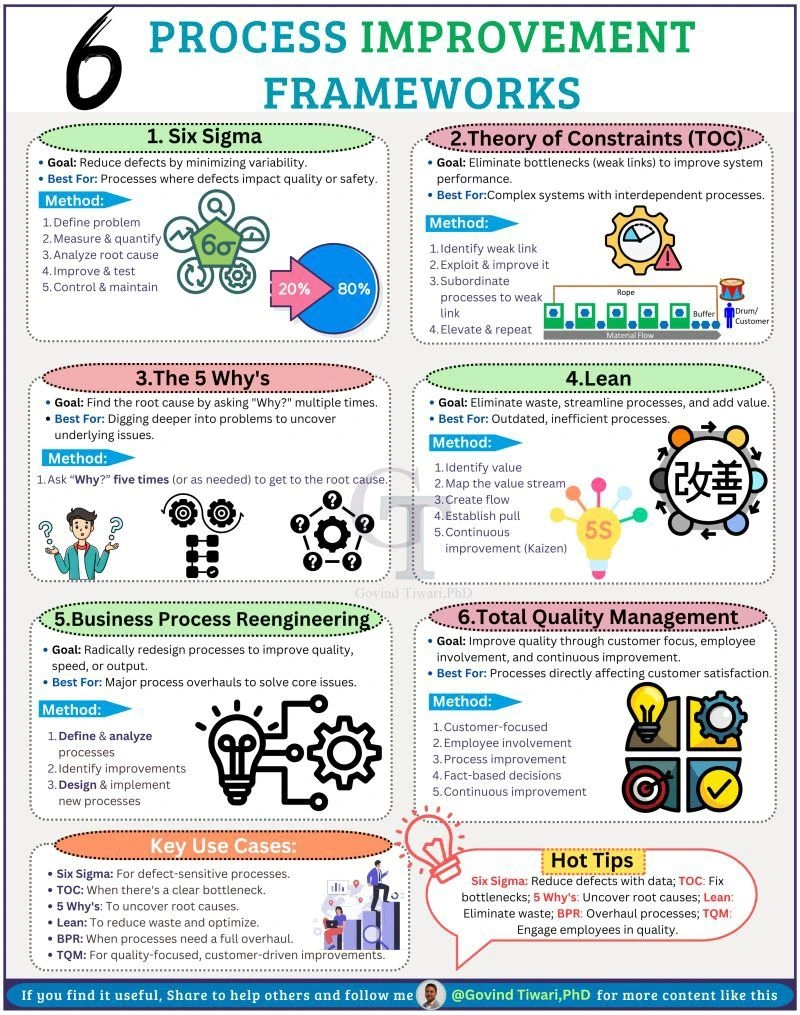
Process Improvement Frameworks
BUD optimization
- Bottlenecks: Identify operations that are slowing down your algorithm
- Unnecessary work: Find operations that can be skipped altogether.
- Duplicated work: Look for calculations that are done more than once.
Cynefin framework
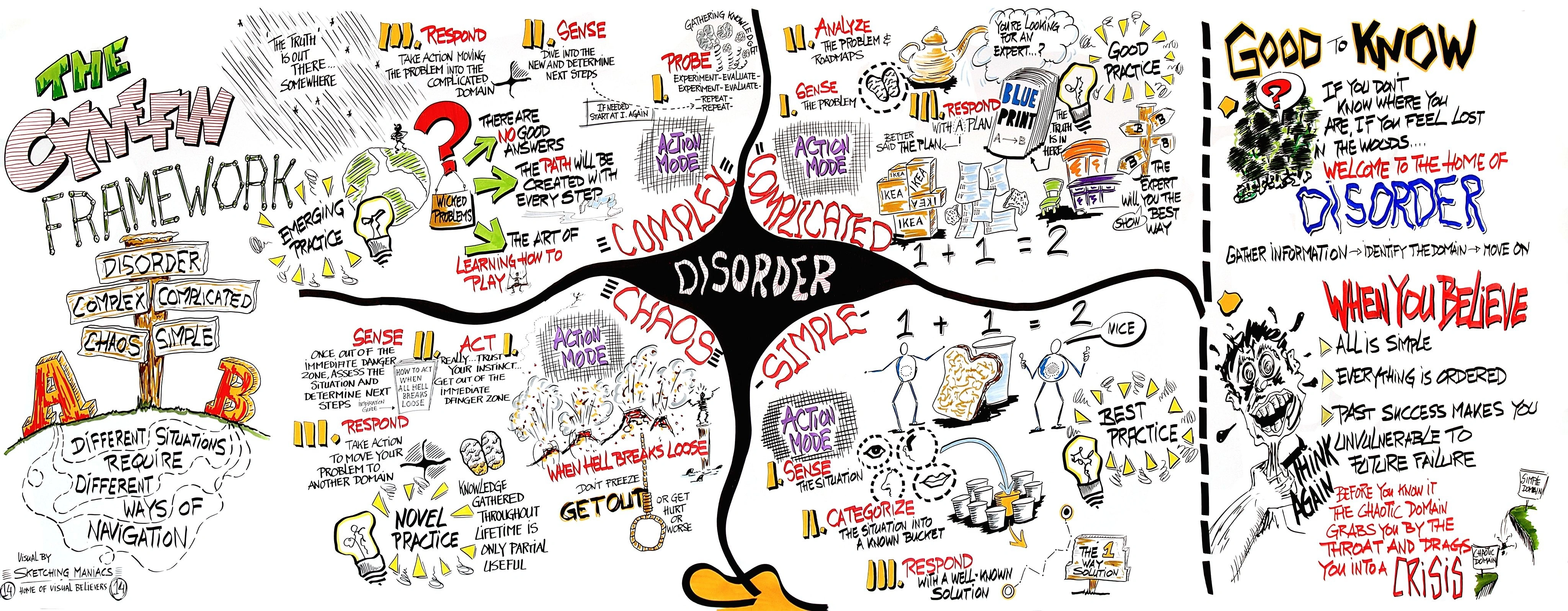
The Cynefin framework is a conceptual model developed by Dave Snowden, a researcher and management consultant, to help understand and navigate complex systems and problems. It provides a framework for making sense of different types of problems and suggests appropriate approaches for addressing them.
The word "Cynefin" (pronounced "kuh-NEV-in") is a Welsh word that roughly translates to "habitat" or "place of belonging." The framework helps individuals and organizations determine the most appropriate "place" or domain to address a given problem based on its characteristics.
The Cynefin framework consists of five domains:
-
Simple (or Obvious): In this domain, problems are clear and cause-and-effect relationships are evident. The solution is usually straightforward and can be determined by following best practices or established rules.
-
Complicated: In the complicated domain, problems are still predictable, but the cause-and-effect relationship is not immediately apparent. Expertise or analysis is required to understand the problem and identify potential solutions. Various approaches, expert opinions, and investigation may be necessary.
-
Complex: In the complex domain, problems are characterized by uncertainty and unpredictability. Cause-and-effect relationships are often identified in retrospect. Instead of finding a single correct answer, multiple perspectives and experiments are needed to understand the problem and discover suitable solutions. This domain emphasizes emergent practices and encourages iterative experimentation.
-
Chaotic: In the chaotic domain, the situation is highly unpredictable and unstable. There are no clear cause-and-effect relationships, and immediate action is required to bring order. The emphasis is on rapidly containing the situation and establishing stability. Once stability is achieved, the situation can be moved into a different domain for further analysis and resolution.
-
Disorder: Disorder is not a domain itself but rather a state where it is unclear which of the other domains the problem belongs to. It serves as a reminder that it is essential to assess and understand the nature of the problem before applying any specific approach.
The Cynefin framework helps decision-makers and problem solvers recognize the nature of the problem they are facing and adapt their thinking and approaches accordingly. It acknowledges that different problems require different approaches and encourages a more nuanced understanding of complexity. By applying the appropriate approach for each domain, individuals and organizations can make better decisions and navigate complex situations more effectively.