Lead Qualification (Lead Qual)
Qualifying Criteria (Sales Fit)
Sales evaluates whether the prospect meets the operational thresholds:
- Budget or the ability to secure budget
- Authority (decision-maker or direct influencer)
- Need for the product or service
- Timeline for buying
- Technical or business feasibility
Many teams use BANT, CHAMP, or MEDDICC for this evaluation.
- Definition: The process of evaluating leads to determine if they are a good fit for your product and if they are likely to become a customer. This is where you separate potential time-wasters from genuine opportunities.
- Key Activities:
- Using a framework like BANT (Budget, Authority, Need, Timing) or CHAMP (Challenges, Authority, Money, Prioritization) to ask strategic questions.
- Sales Development Representatives (SDRs) often handle this stage, qualifying leads before passing them to closers.
- Scoring leads based on their actions (e.g., downloaded a whitepaper vs. requested a demo).
- Output: A confirmed Sales Qualified Lead (SQL) or Opportunity that is passed to an Account Executive to pursue.
How to qualify Leads?
the two most important aspects of selling are asking questions and listening
always always always get them to fill out a questionnaire first before providing a proposal
Ask Questions
Ask good questions and listen carefully to clarify the customer's needs and thoroughly understand the outcomes the customer is looking for.
Do not make the conversation revolve around the technology you use to build a website to one revolving around building solutions for the client.
1st Qualifying Questions
get to know them by asking questions
- client
- goals
- relationships
- financials
- decision-makers / stakeholders / their influencers
- process
- interests
Gain the customer's interest
assess the strength of the opportunity
determine whether the opportunity is valid
begin building out the requirements information
Discuss Outcomes
- Benefit from the product/service confirmed
- Budget confirmed
effectively qualify leads in software consulting and focus your efforts on the most promising opportunities. It's important to remember that lead qualification is an ongoing process, and that you may need to adjust your approach as you gather more information and experience.
Identify your ideal customer: Start by identifying the characteristics of your ideal customer. This might include factors such as industry, company size, location, or budget. This will help you focus your efforts on the most promising leads.
Use lead magnets: Offer a lead magnet, such as a whitepaper, e-book, or webinar, that is relevant to your product or service. This will attract leads who are interested in your offering and help you start building a relationship with them.
Ask qualifying questions: Ask questions that help you determine whether the lead is a good fit for your product or service. These questions might include factors such as their budget, timeline, pain points, or decision-making process.
Score your leads: Assign a score to each lead based on their level of engagement and fit with your product or service. This will help you prioritize your efforts and focus on the most promising leads.
Follow up with leads: Follow up with qualified leads in a timely and personalized manner. This might include a phone call, email, or in-person meeting.
Use a CRM: Use a customer relationship management (CRM) system to track and manage your leads. This will help you stay organized and ensure that you don't miss any important follow-up opportunities.
Define your ideal client: Start by defining the characteristics of your ideal client. This might include factors such as company size, industry, budget, technical expertise, and project scope. This will help you focus your efforts on the most promising leads.
Use targeted messaging: Use targeted messaging in your marketing and outreach efforts to attract leads who are a good fit for your services. This might include creating content that speaks to the pain points and needs of your ideal client.
Ask qualifying questions: Ask questions that help you determine whether the lead is a good fit for your services. These questions might include factors such as their current technology stack, pain points, budget, and timeline.
Assess their readiness: Determine whether the lead is ready to engage in a project. This might involve assessing their current level of need, budget, decision-making process, and timeline.
Score your leads: Assign a score to each lead based on their level of engagement and fit with your services. This will help you prioritize your efforts and focus on the most promising leads.
Follow up with leads: Follow up with qualified leads in a timely and personalized manner. This might include a phone call, email, or in-person meeting.
Use case studies and references: Use case studies and references to demonstrate your expertise and build trust with potential clients. This can help overcome objections and close deals.
Budget
Authority
Needs
- what prompted you to look into ____ services at this time?
- tell me more...
- why did you ...
- when did you ...
- how long have you...
- how did you feel about ____?
Timeline
marketing-sales-psychology.webp)
Discover Outcomes
- Pain points identified
- Customer outcome identified
- Internal sponsors identified
- Decision maker identified
Questions
- Would you like to find out ways to improve your conversion rate, increase your number of warm leads generated, and boost your sales revenue
- Do you need any other promotional material?
- When is the last time you updated the site?
Marketing Consultation Script
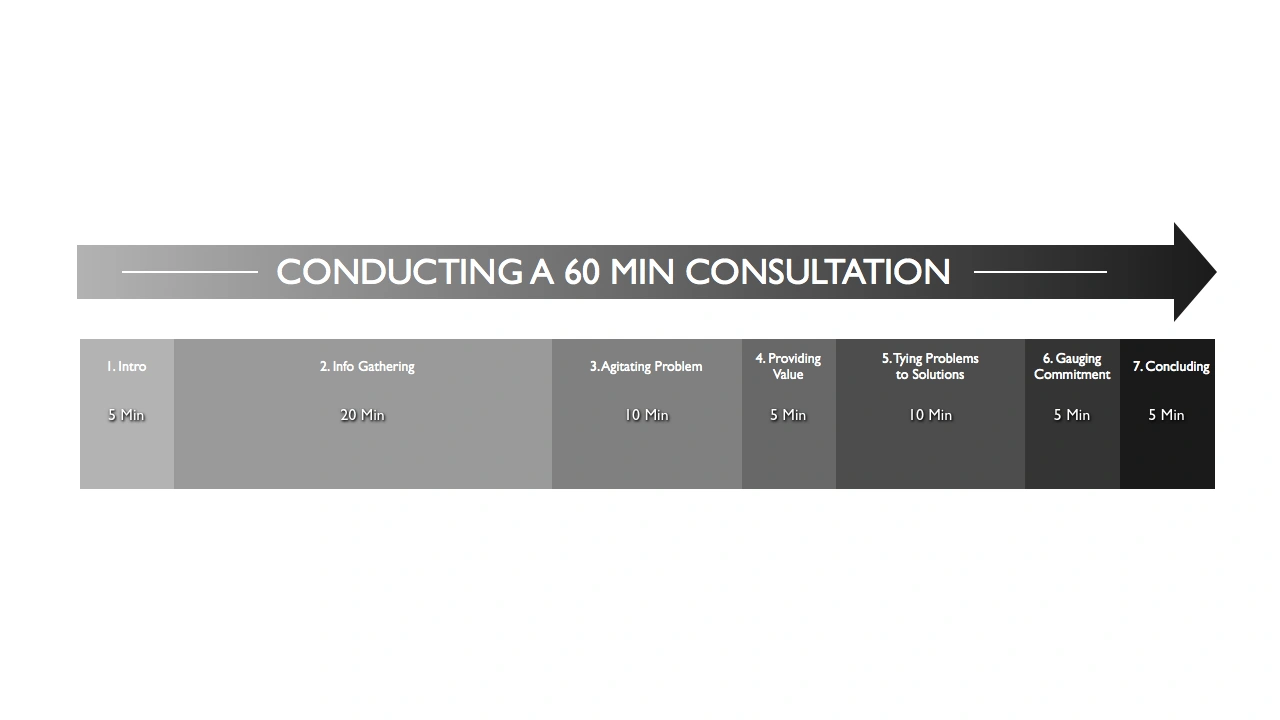
This script will walk you through a typical marketing consultation. It will help you build rapport, establish your expertise, identify how you can help, and naturally lead to a sale.
It also takes the prospect on an emotional rollercoaster, agitating their pain points and showing them the obvious solution.
This script can be used in face-to-face, over the phone or webinar consultations it doesn’t change in structure at all.
Like all scripts, this isn’t to be used “word-for-word”. It is meant to be used as a guideline. For more information on how to use this script please watch “Week 3 – Delivering The Order Using Outsourced Contractors in the CashflowConsulting content portal.
Things To Remember:
• Relax, smile and be yourself • Be aware of their tone, volume, speed and energy and match yours to it • LISTEN! You’re not their to preach you’re there to uncover the gold • Ask to record the consultation and use a device or your phone to do so • Take notes
Quick Breakdown Of Structure:
- Intro, quick chat, build rapport
- Information gathering
- Agitating the problem
- Providing value
- Tying problems to solutions
- Gaining and gauging commitment
- Concluding the consultation
1). Introducing Yourself / Breaking The Ice
Walk in, shake their hand(s), introduce yourself and make light chat about the day, their office or any other form of general conversation just to break the ice and build some rapport.
OK well lets get started...
Now I have a typical way of doing these consultations where I ask you a serries of questions about your business that allows me to identify marketing strategies that will benefit you and help you grow your business. Does that sound good? OK great.
2). Information Gathering
• Tell me about your business. What do you do, who do you do it for, and why should people do business with you over the competition? Discovering Their Deep Desire
• What are your goals for your business over the next year?
• OK, what’s important to you about [ANSWER 1]?
• OK, what’s important to you about [ANSWER 2]?
• And ultimately, what would having [ANSWER 3] do for you?
• Tell me about your current sales process
• How do you get customers?
• What’s your closing ratio?
• Do you follow up with prospects that you don’t close initially?
• How do you stay in touch with past customers?
• Right now how are you trying to grow your business?
• What marketing are you currently doing to get more customers?
• What type of marketing has worked for you best?
• Tell me about your website, how did it come about, who built it?
• What kind of results has it gotten you?
• How many people per week say they found you via your website?
• How many phone calls per week does the website generate?
• How much new business is it directly responsible for?
• How much is your website costing you? Hosting, support, updates etc.
• What don’t you like about your website at the moment?
• What would you like to change?
• What is the worst thing about the website?
• Are you testing and tracking your results online?
• Do you have a database of your customers for marketing purposes?
• How many people are on it, customers? Prospects?
• How are you managing this?
• Do you get many referrals in your business?
What systems do you have in place to encourage referrals?
• What would you say are the top 3 obstacles to overcome to achieve the results you need with your marketing?
3). Agitating The Problem
• How do you feel about your website not performing the way it should?
• How does it make you feel paying that money every month and not seeing the results you’d like?
• How much does it cost you to get a new customer?
• Do you know how much its costs you to get a new lead?
• You told me earlier how your business is different from the competition and why people should do business with you – do you think your website does a good job of showing people that?
• Do you think it’s important to capture leads on your website?
• How come you aren’t currently doing this on your website?
• You told me earlier that you aren’t tracking any of your results online, how does this make you feel?
• Do you think that all of your prospects, leads and customers could be managed more effectively?
• How does it make you feel knowing that sales are slipping through the cracks because your team don’t have things organized?
• Do you think your current website and marketing are aligned to help you achieve [ANSWER 3 FROM DESIRE QUESTION]?
• If you don’t deal with these problems that we’ve talked about, how do you think [ANSWER 3 FROM DESIRE QUESTION] will be affected?
4). Providing Value
OK, so like I’ve said earlier in the letter I sent to you, when you’re selling [PROSPECTS PRODUCT OR SERVICE] people like to go online to do some research first before buying. They want to learn more and make sure they’re making the right decision before buying.
Right now do you think your website is doing a good job of educating people and convincing them to choose your product or service over your competitors?
Pull out your laminated copy of your "Funnel Diagram" I like to use this diagram of a funnel to show how most people in a market like yours go from looking for a solution through to buying.
Its important to have a straight line through this entire funnel so that you can guide prospects through each stage and track each stage to look for blockages in your business.
Right now, just from the questions I’ve been asking you you’re doing the following to:
• Attract traffic [STATE WHAT THEY’RE DOING IN THIS STAGE] • Capture leads [STATE WHAT THEY’RE DOING IN THIS STAGE] • Nurture leads [STATE WHAT THEY’RE DOING IN THIS STAGE] • Convert leads [STATE WHAT THEY’RE DOING IN THIS STAGE] • Close deliver & satisfy [STATE WHAT THEY’RE DOING IN THIS STAGE] • Get referrals [STATE WHAT THEY’RE DOING IN THIS STAGE]
There’s not a straight line through this funnel.
What you have in place is [STATE WHAT THEY HAVE IN PLACE].
This is working because it’s gaining the interest of people who are ready to buy now but not the people who are interested and will buy in the next 18 months. It’s essentially missing a whole bunch of opportunity and customers.
Basically by spending money on advertising you’re pouring more traffic in the top of this funnel and a small increase in customers is coming out the end but you’re still loosing a lot through these leaks.
What I’d suggest is fixing these leaks first and then spending money on advertising to pour traffic into the top of the funnel and a whole lot more customers will come out the bottom because there are no leaks.
Do you see what I’m saying? Does it make sense?
5). Tying Problems To Solutions
------------------------------------------------------------------------------------------------------------------------------ NOTES FOR YOU: You should have written down the main problems that you spotted in their marketing and website and here is where you tie them to solutions and word them correctly so that the prospect tells you how having the solution that you provide would help them. Formula for tying problems to solutions (AIM FOR 5-7 PROBLEM-SOLUTION TIES): OK, so you told me that [STATE PROBLEM YOU DISCOVERED] is a problem. How would it help you if you could [STATE SOLUTION TO PROBLEM]? }}} ------------------------------------------------------------------------------------------------------------------------------
Examples:
• OK so you told me that you don’t have a database of prospects who are interested in your produce but not quite ready to buy now and that this is costing you business. How would it help you if you could capture names and email addresses of interested people on your website so that you could build you own internal list and market to them?
• OK so you told me that you don’t think your website is performing as well as it should and its not doing a good job of educating potential customers and convincing them of why they should choose you over the competition. How would it help you if your website was worded in a customer oriented way that educated customers on the things they need to know before buying and clearly stated why they should do business with you over the competition?
• OK so you told me that right now all quotes are issued and then not stored or logged anywhere, there just emailed or faxed out and never followed up on which is costing you business. How would it help you if every quote ever sent out was stored and logged in an online system and then your team received reminders when to follow up?
6). Gaining & Gauging Commitment
How much is a typical new customer worth to you initially? What about over the course of a lifetime?
OK, so if we could get you just one new customer a week, that would bring in ___ per month, with a lifetime value of __. And over the course of a year you’d be looking at _, with a lifetime value of __. All from just one new customer a week.
Honestly [PROSPECTS FIRST NAME], how would that affect [ANSWER 3 FROM DESIRE QUESTION]? On a scale of 1 to 10, how much do you want your website and online marketing to succeed?
How motivated are you to take action now to fix these problems and get you closer to [ANSWER 3 FROM DESIRE QUESTION]?
7). Concluding The Consultation
OK awesome. Well I’m able to fix all of these problems for you and get your website and online marketing all sorted out so that you can get more customers and get closer to [ANSWER 3 FROM DESIRE QUESTION].
Why don’t I put together a proposal stating all the problems with your current marketing and the solutions I recommend for you to take a look at?
Awesome, I’ll go back to the office, put together the proposal and have it over to you before the end of the day tomorrow. Sound good?
Cool. Thanks [PROSPECTS FIRST NAME]!
-----END OF CONSULTATION----