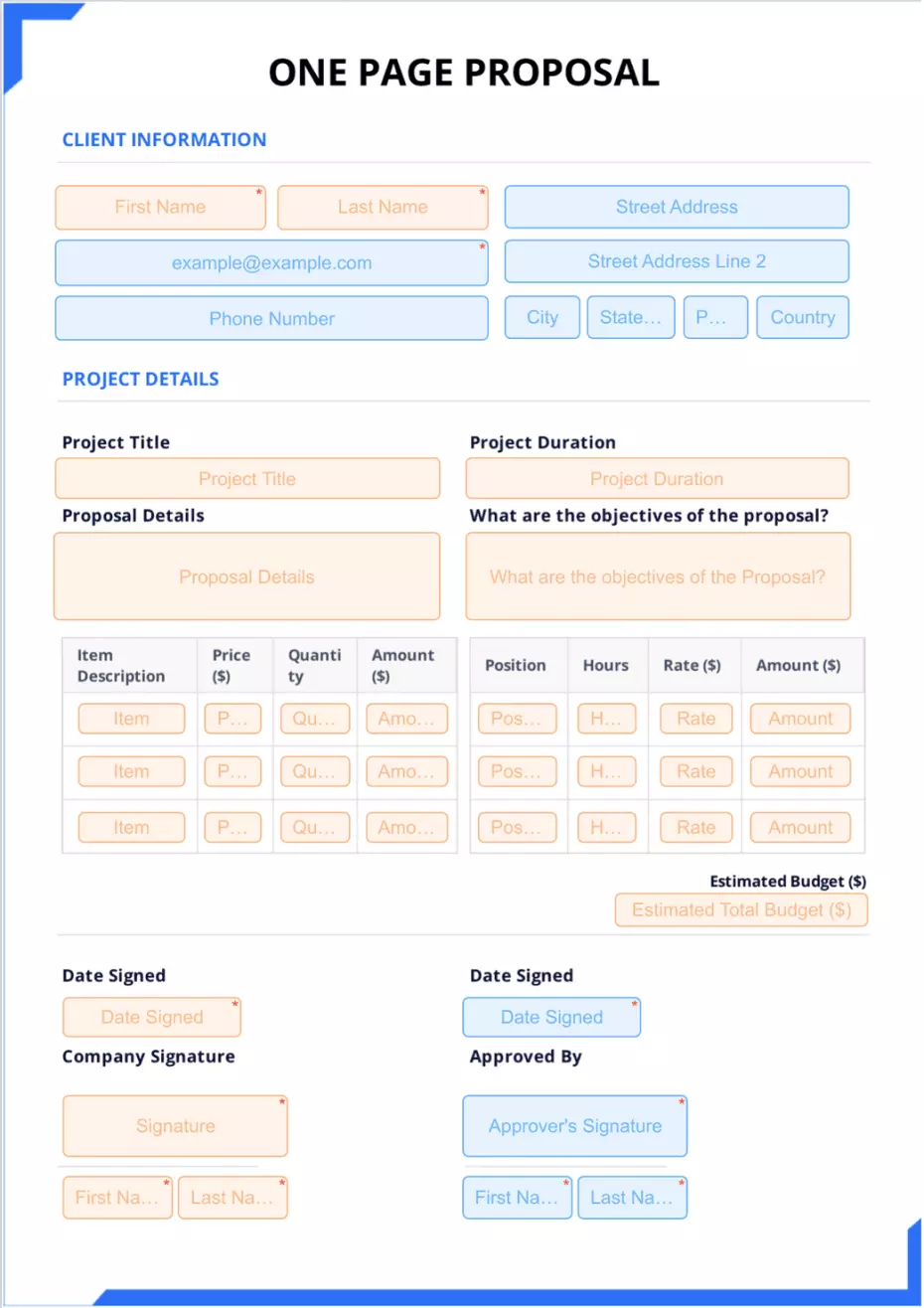
provide client with detailed breakdown of the project cost
Break down the project into deliverables: Divide the project into smaller, manageable deliverables. This helps in estimating time and budget more accurately. Each deliverable should have a clear purpose and defined outcome.
Define the project timeline: Create a detailed timeline that outlines the major milestones, tasks, and dependencies. Consider factors such as design, development, testing, content creation, and client reviews. Ensure that the timeline is realistic and accounts for potential delays or unforeseen circumstances.
Estimate resource requirements: Determine the resources needed to complete the project successfully. This includes the number of designers, developers, project managers, and any other specialists required. Consider the skill level and expertise needed for each role.
Estimate time required for each task: Break down each deliverable into specific tasks and estimate the time required for completion. Consult with the relevant team members to get their input on the effort required for each task. Consider any dependencies between tasks and allocate buffer time for contingencies.
Calculate the cost: Once you have estimated the time required for each task, calculate the cost based on the hourly rates of the resources involved. Multiply the estimated hours by the respective hourly rates to get the cost for each task. Sum up all the task costs to determine the overall project cost.
Consider additional expenses: Take into account any additional expenses that may arise during the project, such as third-party software licenses, hosting fees, or content creation costs. Include these expenses in the overall project cost.
Prepare the RFP document: Compile all the gathered information, including the project scope, timeline, resource requirements, cost breakdown, and any specific terms and conditions. Format the RFP document in a clear and professional manner.
Provide a detailed proposal: Along with the RFP document, prepare a detailed proposal that outlines the project approach, methodology, and the value the web agency will bring to the client. Highlight relevant experience, showcase previous work samples, and provide client testimonials if available.
Present the RFP and proposal: Schedule a meeting or send the RFP and proposal documents to the client. Present the documents in person or via a virtual conference, if possible. Answer any questions the client may have and address any concerns.
Follow up and negotiate: After presenting the RFP and proposal, follow up with the client to see if they have any additional questions or require further clarification. Be open to negotiations and discuss any potential adjustments to the scope, timeline, or budget if necessary.
Reasons to not go for custom web development
Custom Software Development or Off The Shelf? If you are undertaking a software project, you are probably asking yourself if you need to make or buy your solutions. In larger enterprises you may be thinking about implementing something as big as an ERP systems or CRM, or as small as a client intake form or web portal. You ask, is there a commercial off the shelf (cots) software that will meet my needs, or do I need custom software development that will tailor make a solution to fit my needs perfectly?
Here are some things to consider when buying software.
Why use off the shelf software products? Fits a particular need. Oftentimes these are rather niche products that meet a particular need in your company or life. Can be cheap. For a few hundred dollars a month, you get access to a pretty robust system that will hopefully take care of 90% of your needs or more. Outsourced engineering. Other users test the products, and the SaaS company hires the developers to improve the product. Ready to use. These products come stocked with a lot of features to help your company down the road quickly. You have assurance that the software has everything you need because it is industry standard. These apps are great tools, but they are not without their limitations:
Doesn’t fit perfectly. The issue with anything one-size-fits-all is that is doesn’t actually fit anyone well. Ever tried 3-4 different apps and all of them disappoint you? Dev team doesn’t hear your needs. Maybe you thought of an awesome product upgrade, but it doesn’t fit with the SaaS company’s plan and will never get made, or is buried under a stack of other requests. (Take a look at how our Client Empathy project helped a local software startup scale up and implement their solution all over the world, including in the Tesla factory and the largest mine in Chile.) Can be incredibly expensive. Depending on the software you are using and the packages you need, subscription fees could be tens of thousands of dollars a year. When do you need custom software development? Avoid annoying workarounds. Nobody wants to spend hours struggling with tasks they know could be done in minutes with the right custom software. (You can see one of our projects automating a manual data handling process for a Fortune 500 Fintech company here.) You are an innovator. You have an idea that will set you apart from your competition and launch you to the top of your industry. In this case, the custom software is an essential piece of the puzzle that you cannot find in a boxed up solution. Particular functionality. You have specific needs that no SaaS product solves, or your needs are so complex that no off the shelf product will ever meet your exact needs. Get support NOW. When you work with an engineering team, they want to hear YOUR needs. Their support hours go towards what YOU want, not the other 20k users. When you buy custom software development, you are buying dedicated time and attention with engineers. Scaleability. As you grow, your software needs to grow with you to capture the changes in your business needs a logic. Off the shelf solutions are one-size-fits all. Maybe they have all the features you need, but maybe you need custom software that designed to grow with you. Buy instead of rent. Custom software is something you own. You can turn around and sell it if you want, or charge people to use it. Avoid user fees. Although SaaS products can be cheap, usually they hold back the biggest benefits for high dollar monthly packages, and sometimes paying those just doesn’t make sense. Some products end up costing thousands a month, so you end up with a rent or buy decision. Custom software isn’t right for everyone You should look into off the shelf solutions to your problems and see if the solution is out there for cheap! Some problems have already been solved if you just look for them. So do your due diligence before investing.
If you are ready for help with custom software development and are looking for a partner, you can see our 5-star client reviews on GoodFirms and under our Google reviews.
The upfront investment is typically higher with custom work, but you have to think about 2 things:
If you are paying thousands a month in licenses, how soon until you have paid more than the 1 time investment of custom work. Custom software is able to unlock ROI that SaaS products are not able to because IT IS EXACTLY WHAT YOU NEED. At Level 12, we balance the custom work with cost mindfulness through iterative software development. We are able to build exactly what you need while controlling costs by building the most important functionality and only adding features as warranted by the users.
For examples of some of our custom software projects, take a look at our projects page. We are proud that our development efforts have landed us among the top Software Development Companies recognized on DesignRush.
If you are ready to start a custom software development project, contact us for a free estimate.
Procurement in software projects
Procurement in software projects in an enterprise typically follows a process that involves the identification of the software needs, the development of a request for proposal (RFP) or request for quotation (RFQ), the evaluation of vendor proposals, and the selection of a vendor.
Here are the typical steps involved in procurement in software projects in an enterprise:
-
Identify software needs: The first step is to identify the software needs of the enterprise. This may involve identifying the gaps in the existing software, evaluating the software needs of different departments, and determining the budget for the software procurement.
-
Develop a request for proposal (RFP) or request for quotation (RFQ): Once the software needs have been identified, an RFP or RFQ is developed. This document outlines the enterprise’s requirements, the evaluation criteria, and the timeline for the procurement process.
-
Vendor selection: Vendors are invited to submit proposals in response to the RFP or RFQ. The proposals are evaluated based on the evaluation criteria outlined in the RFP or RFQ. The evaluation may involve reviewing the vendor’s experience, qualifications, technical skills, pricing, and proposed implementation approach.
-
Negotiation and contract finalization: After the vendor has been selected, negotiations are conducted to finalize the contract. The contract typically outlines the scope of the software project, the timelines for implementation, the payment terms, and the deliverables.
-
Implementation and ongoing support: Once the contract has been finalized, the software implementation process begins. The vendor works closely with the enterprise to implement the software and provide ongoing support.
Overall, the procurement process in software projects in an enterprise involves a thorough evaluation of the enterprise’s software needs, the development of a detailed RFP or RFQ, the evaluation of vendor proposals, and the selection of a vendor that best meets the enterprise’s requirements.
evaluation criteria
There are several common evaluation criteria that enterprises use to evaluate vendor proposals for software projects. These criteria typically vary depending on the specific needs of the enterprise and the software project, but some common ones include:
-
Technical expertise: This criterion evaluates the vendor's technical skills and expertise in delivering software solutions that meet the enterprise's requirements. The enterprise may look at the vendor's experience in similar projects, the qualifications of their technical team, and their technical approach to the project.
-
Functional requirements: This criterion evaluates how well the vendor's proposed solution meets the enterprise's functional requirements. The enterprise may look at the vendor's proposed features, functionalities, and how well they align with the enterprise's needs.
-
Implementation approach: This criterion evaluates the vendor's proposed implementation approach, including the timeline, resources, and methodology. The enterprise may look at how well the vendor's approach aligns with their own project management and implementation processes.
-
Pricing: This criterion evaluates the vendor's proposed pricing for their solution and services. The enterprise may compare the vendor's pricing to other proposals and may evaluate the value for money provided by the vendor.
-
Support and maintenance: This criterion evaluates the vendor's proposed support and maintenance services, including the level of support, response times, and ongoing maintenance costs. The enterprise may look at the vendor's track record in providing support and maintenance services.
-
Vendor reputation: This criterion evaluates the vendor's reputation in the market, including their reliability, financial stability, and customer satisfaction. The enterprise may look at the vendor's references, reviews, and ratings to evaluate their reputation.
Overall, the evaluation criteria used to evaluate vendor proposals for software projects depend on the specific needs of the enterprise and the software project. Enterprises often use a combination of these criteria to evaluate vendor proposals and select the vendor that best meets their requirements.
Outsourcing
Outsourcing, procurement, and project management in software projects can be complex and challenging, and there are several common pitfalls that enterprises may encounter. Here are some examples of common pitfalls:
1. Lack of clear requirements: One common pitfall is a lack of clear requirements. If the enterprise's requirements are not clearly defined, it can lead to misunderstandings and miscommunications between the enterprise and the vendor, which can result in delays, cost overruns, and a final product that does not meet the enterprise's needs.
2. Poor vendor selection: Another common pitfall is poor vendor selection. If the enterprise chooses the wrong vendor, it can lead to delays, poor quality work, and cost overruns. It is important to conduct a thorough evaluation of potential vendors and select a vendor that has the necessary skills, experience, and expertise to deliver the project successfully.
3. Inadequate project management: A lack of adequate project management can also be a pitfall. If the enterprise does not have a clear project plan, project milestones, and project management processes in place, it can lead to delays, misunderstandings, and miscommunications.
4. Poor communication: Poor communication between the enterprise and the vendor can also be a pitfall. If the enterprise does not communicate its requirements clearly, it can lead to misunderstandings and miscommunications, which can result in delays and cost overruns.
5. Insufficient quality assurance and testing: Insufficient quality assurance and testing can also be a pitfall. If the enterprise does not have a robust quality assurance and testing process in place, it can result in a final product that is of poor quality, which can lead to customer dissatisfaction and reputational damage.
6. Cultural and language differences: Finally, cultural and language differences between the enterprise and the vendor can also be a pitfall. If the enterprise and the vendor do not have a good understanding of each other's culture and language, it can lead to misunderstandings and miscommunications, which can result in delays and poor quality work.
Overall, to avoid these and other common pitfalls, it is important for enterprises to have a clear understanding of their requirements, conduct a thorough evaluation of potential vendors, have a robust project management process in place, communicate effectively with the vendor, and have a robust quality assurance and testing process
Well-Scope Requirements
Ensuring that your requirements are clear enough for the vendor is critical to the success of a software project. Here are several steps you can take to ensure that your requirements are clear enough for the vendor:
1. Define your requirements in detail: Take the time to define your requirements in detail. This includes specifying the features, functions, and characteristics of the software you need. The more detailed and specific your requirements are, the easier it will be for the vendor to understand what you need.
2. Use clear and concise language: Use clear and concise language when defining your requirements. Avoid using technical jargon or complex language that the vendor may not understand. Use simple and straightforward language that accurately conveys your needs.
3. Provide examples: Providing examples can help the vendor understand your requirements better. Show the vendor what you are looking for by providing examples of similar software solutions or features that you like.
4. Prioritize your requirements: Prioritize your requirements to help the vendor understand which requirements are most important to you. This can help the vendor focus on the most critical requirements and ensure that they are met.
5. Use diagrams and visual aids: Use diagrams and visual aids to help explain your requirements. This can help the vendor visualize the software solution and understand how it should function.
6. Conduct a requirements review: Before finalizing your requirements, conduct a requirements review with the vendor. This can help ensure that the vendor fully understands your requirements and that there are no misunderstandings or miscommunications.
7. Establish a clear communication plan: Establish a clear communication plan with the vendor to ensure that you can communicate any changes or updates to your requirements effectively. This can help ensure that the vendor is always working with the most up-to-date information.
Overall, ensuring that your requirements are clear enough for the vendor requires careful attention to detail, clear communication, and ongoing collaboration with the vendor throughout the software development process.
Estimating app costs
Estimating app development labor costs can be a complex process that involves a number of factors. Here are some steps you can take to help you estimate app development labor costs:
Define the app requirements: Before you can estimate labor costs, you need to have a clear understanding of the app's requirements. This includes the features and functionality required, the technology stack, user experience design, and any other relevant factors.
Break down the project into tasks: Once you have defined the app requirements, you can break down the project into individual tasks that need to be completed. This can help you estimate the amount of time and effort required for each task.
Estimate the time required for each task: Once you have broken down the project into tasks, you can estimate the time required for each task. This can be done by consulting with developers and other experts who have experience with similar projects.
Calculate the labor costs: Once you have estimated the time required for each task, you can calculate the labor costs by multiplying the estimated time by the hourly rate for each developer working on the project.
Include additional costs: In addition to labor costs, you should also factor in other costs such as hardware, software licenses, and any other expenses related to the project.
Consider contingencies: App development projects can be unpredictable, so it's a good idea to include some contingency in your estimates to account for unexpected delays or changes in requirements.
Remember, estimating app development labor costs is not an exact science, and there are many factors that can impact the final cost. It's important to work with experienced developers and project managers who can help you refine your estimates and ensure that your project stays on track and within budget.
Getting accurate time and complexity estimations for software projects can be a challenging task. Here are some tips to help you get more accurate estimations:
Break down the project into smaller tasks: Breaking the project down into smaller tasks makes it easier to estimate individual components and provides a clearer picture of the overall project complexity. This allows you to estimate the time and effort required for each task more accurately.
Use historical data: Historical data from previous projects can provide insight into the time and complexity of similar projects. Use this data to inform your estimations and adjust for any differences in the current project.
Involve the development team: Involve the development team in the estimation process, as they have the most relevant experience and knowledge of the project. Their insights can provide a more accurate estimation of the time and complexity involved.
Use estimation techniques: There are several estimation techniques that can be used to estimate software project time and complexity, such as the Wideband Delphi technique, Planning Poker, and PERT analysis. Consider using these techniques to help you arrive at more accurate estimations.
Consider risk factors: Identify and factor in any potential risks or unknowns that may impact the project timeline and complexity. This can include issues with technology, resource availability, and external factors such as market changes or regulatory requirements.
Re-evaluate and adjust: Re-evaluate the estimations as the project progresses and adjust as necessary. This allows you to identify any issues early and make necessary changes to stay on track.
Remember, accurate software project time and complexity estimations are essential for project success. By breaking down the project, using historical data, involving the development team, using estimation techniques, considering risk factors, and re-evaluating and adjusting as necessary, you can improve the accuracy of your estimations and increase the likelihood of project success.