Closing the Deal
- Definition: The process of working with a qualified lead to address their final objections, negotiate terms, and secure a signed contract or purchase.
- Key Activities:
- Demonstrations: Showing how the product specifically solves the prospect's challenges.
- Proposals & Quotes: Sending formal documents outlining the solution, scope, and price.
- Negotiation: Discussing terms, pricing, and contract details.
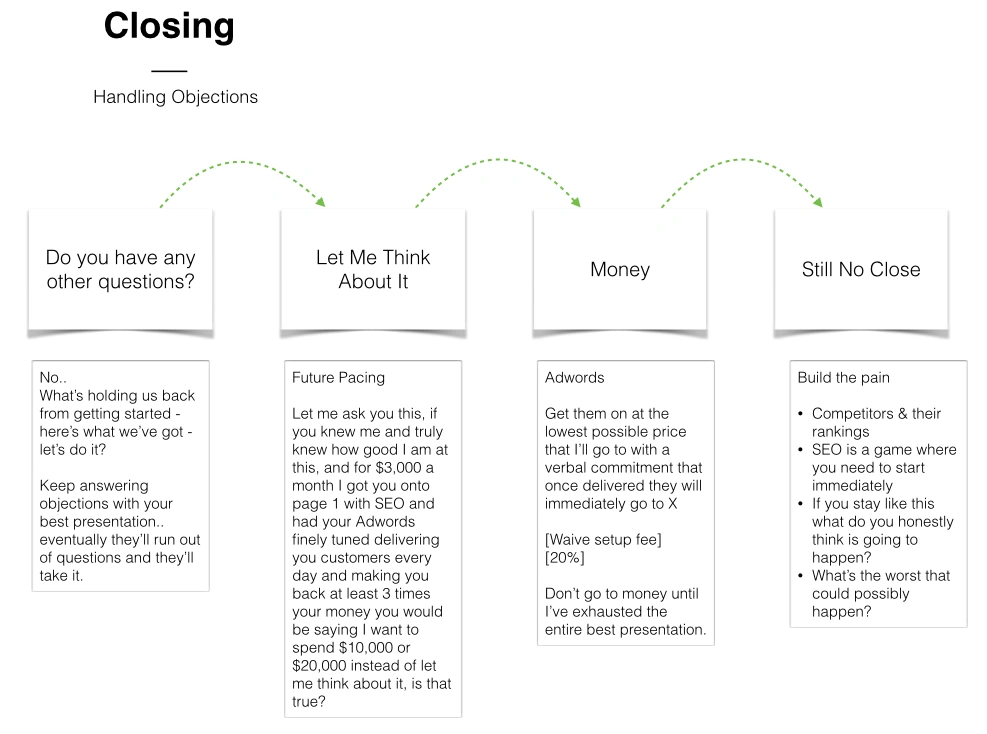
- Objection Handling: Overcoming final concerns about cost, timing, or competitors.
- Asking for the Sale: The final step of getting a commitment.
- Output: A Closed-Won deal (new customer) or a Closed-Lost deal (the prospect chose not to buy).
Common Objections
counter the objection: “I don’t need a website, I have [X] social media page that drives sufficient traffic.”
Use these as quick, factual counters to highlight the unique value and necessity of having a professional website alongside any social media strategy.
-
Credibility & Trust: 84% of consumers believe a business with a website is more credible than one with only social media presence (Verisign survey).
-
Search Visibility: 93% of online experiences begin with a search engine; websites rank in Google, while social pages rarely do (Forrester Research).
-
Ownership & Control: You fully own your website and its content; social media platforms can change rules or ban accounts without notice.
-
Conversion Rates: Websites convert visitors into customers at rates up to 5x higher than social media traffic (HubSpot benchmark data).
-
Brand Customization: Websites allow complete branding and customization; social media pages restrict design and messaging options.
-
Analytics Power: Website analytics (Google Analytics) provide deeper insights into visitor behavior, allowing better optimization than social media analytics.
-
Lead Generation Tools: 80% of businesses say their best leads come from their website forms, not social media messages (SmallBizTrends).
-
Professionalism: 75% of consumers judge a company’s credibility based on its website design (Stanford Web Credibility Research).
-
Multi-Channel Integration: Websites seamlessly integrate with email marketing, online ads, and e-commerce—social media is limited.
-
Long-Term ROI: Businesses with websites see up to 40% higher long-term ROI compared to those relying solely on social media (Clutch.co study).
POSTPURCHASE BEHAVIOR
- Customer Satisfaction Studies
- Satisfied Customers > Tell 3 People
- Dissatisfied Customers > Tell 9 People
- Cognitive Dissonance