Business Terms
| Terms | Defintions |
|---|---|
| Mission Statement | see mission statement |
| business model | the high-level strategic framework that outlines how a business will make money |
| Key Performance Indicators (KPI) | |
| Objectives and Key Results | OKR stands for Objectives and Key Results |
| Revenue Growth Model: monthly recurring revenue (MRR) | is a critical metric, used to measure predictable, recurring revenue. |
| Operational Tasks | day to day activities that are ongoing and repetitive. |
| MoM MRR Growth (%) | = Net MRR (This Month) - Net MRR (Last Month) / Net MRR (Last Month) |
| Services | is a broad term used in various development methodologies to refer to a function or group of functions designed to do something specific. You'll see it used in microservice architecture, service-oriented architecture, domain-driven design, and many others. |
| Strategic positioning | the view of a company that results from its strategy-driven decision making. It involves choosing a competitive strategy, a target market, and a unique solution based on the company’s capabilities and the positions of its rivals. It aims to meet the customers’ needs, generate revenue, and withstand market fluctuations. a company’s relative position within its industry. It reflects the choices a company makes about the kind of value it will create and how that value will be created differently than rivals. According to Porter’s generic strategy matrix, companies can be segmented in two ways: narrow and broad scope, cost and differentiation source of competitive advantage. |
| MoM MRR Growth Definition | For software companies operating under monthly subscription revenue models, monthly recurring revenue (MRR) is a critical metric, used to measure predictable, recurring revenue. Month over Month (MoM) MRR growth is a measure of forward momentum, market traction and business expansion. MoM MRR Growth is calculated by subtracting Net MRR in the current period from Net MRR in the previous period, and dividing that figure by Net MRR in the previous period. Net MRR is calculated by adding Expansion MRR (increasing monthly recurring revenue generated through a current client) to New MRR (monthly recurring revenue contracts beginning in the current period), and subtracting lost MRR or “Churn” (MRR lost in the period due to the cancellation or non-renewal of contracts). |
| war chest | any collection of tools or money intended to be used in a challenging or dangerous situation. Amassed funds, expertise, and/or equipment which allows a person or organization to survive a challenging situation. |
| Yield farming: | coupon cutting for investing |
| single member LLC operating agreement | a legal document that outlines the ownership and operating procedures of a single member LLC, which is a limited liability company with only one owner. |
| That's an excellent question for a business plan, as these terms are frequently used yet carry distinct strategic weight. As someone who runs a small agile tech firm, defining these clearly is crucial for communicating your defensibility and long-term vision to partners and investors. |
Here is a breakdown differentiating Competitive Edge, Competitive Advantage, and Unfair Advantage.
🚀 Strategic Differentiation: Edge, Advantage, and Unfair Advantage
| Term | Definition in a Business Context | Key Characteristics | Business Plan Focus |
|---|---|---|---|
| Competitive Edge | A simple, usually short-term, attribute that makes your offering slightly better or more appealing right now. | Tacit, Temporary. Often related to a specific feature, a temporary pricing promotion, superior marketing copy, or a single operational efficiency. | Marketing & Sales: Used to highlight immediate market positioning and USP (Unique Selling Proposition) for customers. |
| Competitive Advantage | A broader, more substantial set of attributes that allows a company to generate superior value or profits over the long term. | Explicit, Measurable, Sustained. Must be valuable, rare, and relatively difficult (though not impossible) to imitate. | Strategy & Operations: A core part of the overall strategy (e.g., cost leadership, differentiation). It explains how you will win and maintain market share. |
| Unfair Advantage | A unique, proprietary, or deeply embedded resource or circumstance that cannot be easily copied, bought, or replicated by any amount of money or effort. | Defensible, Exclusive, Proprietary. Often referred to as a "moat." It creates a formidable barrier to entry for competitors. | Defensibility & Investor Pitch (Lean Canvas): Used to prove long-term sustainability and exponential growth potential. It answers: "Why will we succeed when others fail to copy us?" |
1. Competitive Edge (The Immediate Lead)
Think of the competitive edge as your Unique Selling Proposition (USP)—it's what gets the first conversion.
- Example (Tech Firm): A competitor offers a standard 30-day trial; you offer a 45-day trial (your edge). Your latest digital marketing campaign uses a cutting-edge, newly released AI tool for hyper-personalization, giving you a temporary lead in ad efficiency.
- Significance: It's the point of difference that helps a customer choose you today. However, it's easily lost or replicated.
2. Competitive Advantage (The Sustainable High Ground)
This is the established framework that keeps you ahead. In the context of the VRIO framework, a competitive advantage is generally valuable and rare but often imitable, even if it takes time and investment.
- Example (Tech Firm): You've optimized your agile development process over five years, achieving a 20% faster time-to-market for new features than the industry average (a cost/efficiency advantage). Or, you offer a highly specialized suite of integration services that are difficult for generic agencies to match (a differentiation advantage).
- Significance: It defines your strategy for long-term survival and profitability.
3. Unfair Advantage (The "Moat")
This term, popularized in the startup and Lean Canvas communities, is the most powerful. It is the attribute that makes your success look "unfair" to competitors because they simply cannot get it. It must pass the "cannot be easily copied or bought" test.
-
Example (Tech Firm/Digital Marketing Studio):
- Proprietary IP: A patent on a novel AI-driven ad-buying algorithm.
- Cornered Resource: Exclusive rights to a massive, unique, and non-public dataset of consumer behavior (your "data moat").
- Dream Team: Your co-founder is a legendary figure in the industry, granting immediate credibility and access to an unparalleled network of top-tier talent and clients.
- Network Effects: For a platform you build, its value to each new user increases exponentially with every existing user (e.g., social media or marketplace).
-
Significance: This is the ultimate defensive strategy. It's what investors look for to ensure your business is resilient against well-funded competition and market shifts.
As a front-end developer and tech firm leader, your business plan should articulate how your initial competitive edge in a specific market niche will be leveraged to build a more lasting competitive advantage (e.g., superior service, optimized processes), which is ultimately protected and amplified by your unfair advantage (e.g., proprietary technology, exclusive partnerships, or the deep expertise of your "dream team").
Total Addressable Market
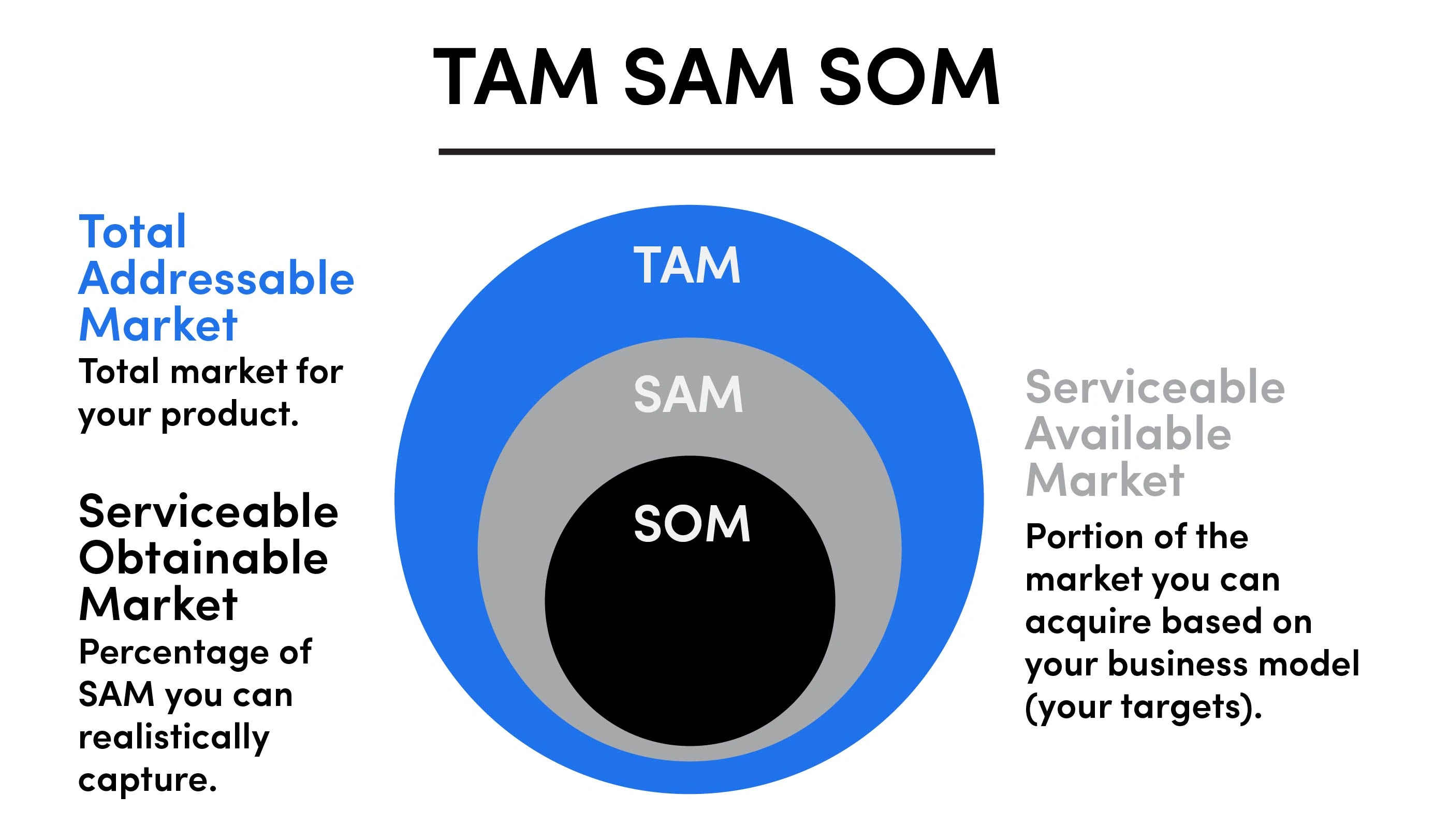
Total Addressable Market (TAM) refers to the maximum size of the opportunity for a particular product or solution. It represents the entire market demand for a product or service, calculated in annual revenue or unit sales, assuming 100% market share. In other words, TAM is the total potential market size if every single person who could potentially find value in a product or solution were to purchase or use it.
TAM is not a measure of actual future customers or revenue, as competitors and alternative solutions can also address the market. Instead, it provides stakeholders with a sense of the total market size before it gets divided among companies, competitors, and potential customers who choose not to use or purchase anything.
The fundamental math equation for calculating TAM is a simple multiplication problem:
Average Revenue Per User (ARPU) × Total Number of Potential Customers in the Target Market
ARPU is a straightforward metric that can be adjusted as part of business planning, while the second component requires estimating the total number of potential customers in the target market.
TAM serves as a valuable framework for businesses to:
- Prioritize market opportunities
- Focus strategic marketing and sales efforts
- Address actual customer needs
- Estimate potential revenue and growth
By understanding the Total Addressable Market, businesses can make informed decisions about their market positioning, competitive strategy, and resource allocation.
Blue Sky
The term "blue sky" is used for business ideas that are not yet practical or profitable in several common situations:
-
Brainstorming Sessions: When businesses hold brainstorming sessions to generate new ideas, they encourage "blue sky thinking." This means putting aside limitations and practicality for a moment to explore all possibilities, no matter how outlandish. The goal is to come up with a wide range of ideas that can then be evaluated for feasibility.
-
Innovation & Disruption: Companies looking to disrupt their industry or develop groundbreaking products often use blue sky thinking. These ideas might involve entirely new technologies, radical changes in business models, or solutions that address problems in completely new ways. Since they're pushing boundaries, they might not be immediately practical or profitable.
-
Long-Term Vision: When businesses develop their long-term vision, they might consider "blue sky" ideas to set aspirational goals. These goals might not be achievable in the immediate future, but they provide a direction for future research, development, and innovation.
-
Problem-Solving from Different Angles: If a company is stuck with a complex problem, blue sky thinking can help them break out of conventional solutions. By exploring seemingly outlandish ideas, they might stumble upon a totally new approach to tackle the issue. Even if the idea itself isn't directly implemented, it could spark inspiration for a more practical solution.
-
Future Technologies: When considering the potential of emerging technologies like artificial intelligence or virtual reality, blue sky thinking helps businesses brainstorm how these technologies might revolutionize their industry or create entirely new business opportunities. The specific applications might not be clear yet, but exploring the possibilities can lead to valuable insights.
Remember, "blue sky" ideas are not guaranteed to succeed, but they can be a valuable springboard for innovation and future growth.
Business Models
private label and white label
The terms private label and white label get tossed around a lot, and while they're similar, there are some key distinctions. Let's break down the two main "label" business models:
1. Private Label:
- Focus: Physical Products (Think grocery stores, clothing lines)
- The Deal: A manufacturer produces a product according to a retailer's specifications, but the retailer brands and sells it under their own name.
- Who's Who:
- Private-label manufacturer: Makes the product based on the retailer's design and quality standards.
- Private-label retailer: Develops the brand, markets the product, and sells it to consumers.
- Examples: Grocery store chains with their own brand of cereal, clothing stores with private label jeans.
2. White Label:
- Focus: Can be physical products, software, or services (Think software as a service - SaaS)
- The Deal: A manufacturer or service provider creates a generic product or service. A reseller then purchases it and brands it as their own.
- Who's Who:
- White-label provider: Develops the core product or service but leaves it unbranded.
- White-label reseller: Customizes the branding and sells it to their customers.
- Examples: A company that rebrands and resells pre-designed marketing software, a web designer who uses a white-label website building platform.
Here's a table summarizing the key differences:
| Feature | Private Label | White Label |
|---|---|---|
| Product Type | Physical Products | Physical, Software, Services |
| Branding | Retailer's Brand | Reseller's Brand |
| Customization | High (Specifications) | Lower (Branding Only) |
In essence:
- Private label is about creating a unique branded product for a specific retailer.
- White label is about taking a pre-made product or service and customizing the brand for resale.