Organization Design
Team Topologies
Team Topologies is a framework for organizing and optimizing team structures in tech organizations, including startups, to enhance software delivery and business agility. It focuses on designing teams based on their purpose, interactions, and cognitive load to align with business goals and enable fast, effective product development. In the context of tech startups, where resources are often limited and adaptability is critical, Team Topologies framework provides a structured approach to scale teams while maintaining innovation and speed.
Key Concepts of Team Topologies
-
Team Types:
- Stream-Aligned Teams: These teams focus on delivering value to customers through end-to-end ownership of a product, feature, or user journey (e.g., a startup’s core app feature). In a startup, this might be a small cross-functional team responsible for a specific product area, like the user onboarding flow.
- Enabling Teams: These teams support stream-aligned teams by providing expertise or tools to overcome obstacles (e.g., a DevOps specialist helping automate deployments). In startups, this role might be filled by a shared resource, like a senior engineer mentoring others.
- Complicated-Subsystem Teams: These teams handle complex, specialized components requiring deep expertise (e.g., a machine learning model for a startup’s recommendation engine). Startups may not always have these teams due to resource constraints but might rely on external consultants or a single specialist.
- Platform Teams: These teams build and maintain internal platforms to simplify work for stream-aligned teams (e.g., a shared API or cloud infrastructure). In early-stage startups, platform teams are often minimal or combined with enabling roles due to limited headcount.
-
Team Interaction Modes:
- Collaboration: Teams work closely together for a defined period to solve a problem or innovate (e.g., a startup’s product and design teams co-creating a new feature).
- X-as-a-Service: One team provides a service or tool to others with minimal ongoing interaction (e.g., a platform team offering a self-service deployment tool).
- Facilitating: One team helps another achieve a goal, often through training or guidance (e.g., an enabling team teaching a stream-aligned team to use a new testing framework). In startups, collaboration is common early on due to fluid roles, but as the company grows, clearer interaction modes reduce chaos.
-
Cognitive Load Management:
- Teams should be sized and scoped to manage cognitive load (intrinsic, extraneous, and germane). In startups, this means keeping teams small (5-9 people, per Dunbar’s number and Amazon’s “two-pizza rule”) and focused on specific outcomes to avoid burnout and inefficiency.
- Example: A startup might have one stream-aligned team handling both frontend and backend initially but split them as complexity grows.
-
Evolving Team Structures:
- Team Topologies emphasizes that team designs should evolve with the startup’s growth. Early-stage startups might have a single, highly collaborative team, but as they scale (e.g., post-Series A), they may introduce stream-aligned and platform teams to handle increased product complexity and customer demands.
- The framework encourages regular reflection to adjust team boundaries and interactions based on bottlenecks or changing priorities.
Application in Tech Startups
-
Early-Stage Startups (1-20 employees):
- Often operate with one or two highly collaborative, cross-functional teams combining stream-aligned and enabling roles.
- Example: A team of engineers, designers, and a product manager builds the MVP, with individuals wearing multiple hats (e.g., a developer also handles DevOps).
- Interaction is mostly collaboration due to shared goals and limited specialization.
- Cognitive load is high, so startups must prioritize clear communication and simple tools.
-
Growth-Stage Startups (20-100 employees):
- Begin adopting distinct stream-aligned teams for different product areas (e.g., one team for payments, another for user profiles).
- May introduce a small platform or enabling team to reduce duplication (e.g., a shared infrastructure team managing AWS).
- Interaction modes shift toward X-as-a-Service to scale efficiently (e.g., a platform team provides APIs for others to consume).
- Startups must balance specialization with flexibility, as roles are still less rigid than in large enterprises.
-
Key Benefits for Startups:
- Faster Delivery: Stream-aligned teams with clear ownership reduce handoffs and accelerate feature releases.
- Scalability: Evolving team structures support growth without creating silos.
- Resource Efficiency: Clear interaction modes minimize redundant work, critical for lean startups.
- Employee Retention: Managing cognitive load and empowering teams fosters engagement in high-pressure startup environments.
-
Challenges in Startups:
- Limited headcount makes it hard to create specialized teams (e.g., a dedicated platform team).
- Rapid pivots require frequent team restructuring, which can disrupt flow.
- Cultural resistance to formalizing team boundaries in small, “all-hands” startup cultures.
Example in a Tech Startup
A fintech startup with 30 employees builds a mobile banking app. Initially, one team handles everything. As the app grows, they adopt Team Topologies:
- Two stream-aligned teams: One for payments, another for account management, each owning their feature end-to-end.
- One enabling team: A senior DevOps engineer helps both teams improve CI/CD pipelines.
- Interaction mode: The enabling team facilitates training, while stream-aligned teams collaborate on shared UX components.
- Outcome: Faster feature releases, less downtime, and clearer ownership, enabling the startup to compete with larger players.
Source Context
The Team Topologies framework, developed by Matthew Skelton and Manuel Pais, is detailed in their 2019 book Team Topologies: Organizing Business and Technology Teams for Fast Flow. Recent web sources (e.g., teamtopologies.com, medium.com posts from 2024-2025) highlight its growing adoption in startups for scaling DevOps and agile practices. Posts on X also reflect its use in aligning teams with microservices architectures, a common startup pattern.
By applying Team Topologies, tech startups can structure teams to deliver value quickly, adapt to growth, and maintain agility in a competitive landscape.
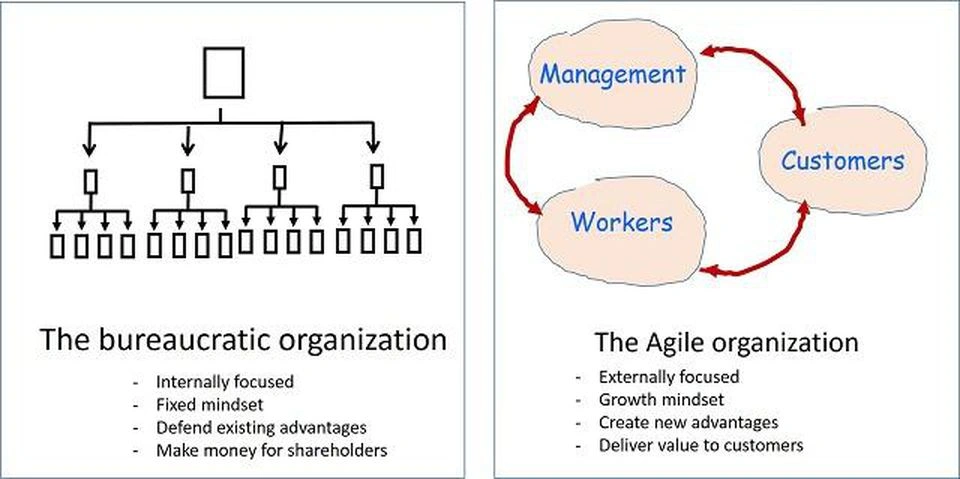

How many Team Members?
marketing agency
- most agencies should have 10-20 active clients for maximum profits and minimum headaches.
- Another source suggests that agency leaders should be mindful of the "heartbeat" of their organization, ensuring it's sustained by many people rather than relying on a single charismatic founder.
- In terms of team size, one account manager shared their experience managing 60 clients, with a junior analyst team handling the day-to-day work. Another individual mentioned having 4-6 core clients, with themselves and one junior person handling the work.
A small to medium-sized agency might have a team of 2-5 people, handling a manageable number of clients (10-20) and focusing on a specific niche or service offering. A larger agency might have a team of 10-20 people, handling a larger client base (20-50) and offering a broader range of services. Agencies with a high volume of clients (50+) might require a larger team of 20-50 people, with specialized roles and departments (e.g., account management, creative, analytics).
Keep in mind that these are rough estimates and may vary depending on factors such as:
- Agency size and scope
- Service offerings and niches
- Client complexity and requirements
- Team structure and roles
- Agency culture and workflow
Game Studio
small-tier game development: (around 10-50 people)
- Small to Medium Studios: These studios usually have teams of 15 to 50 people, focusing on smaller-scale projects.
Indie Games
- Typically, a solo developer (1 person) or a small team of up to 10 people can develop a game.
For a bare minimum, a small-tier game development team would require
- Programmer: 1
- Designer: 1
- Project Manager: 1
- Tester/Quality Assurance: 1
This team of 4-5 people can handle the core development, design, and testing aspects of a small-tier game. However, it's worth noting that having a producer involved can be beneficial for marketing and publishing purposes, even in small teams.
Keep in mind that these numbers are general estimates and may vary depending on the specific project's scope, complexity, and genre.
Career Paths
- career progression
bridging the gap between marketing and design teams
There is no QA role in an agile team
because devs have to do it all and focus on quality. devs don't push defective code in the first place
Agile project iterations are designed to enable teams to respond quickly and efficiently to changes in project requirements and customer needs. As a result, organizations may need to make changes to their team structure or organization design in order to fully adopt an agile approach.
common changes that organizations make during agile project iterations include
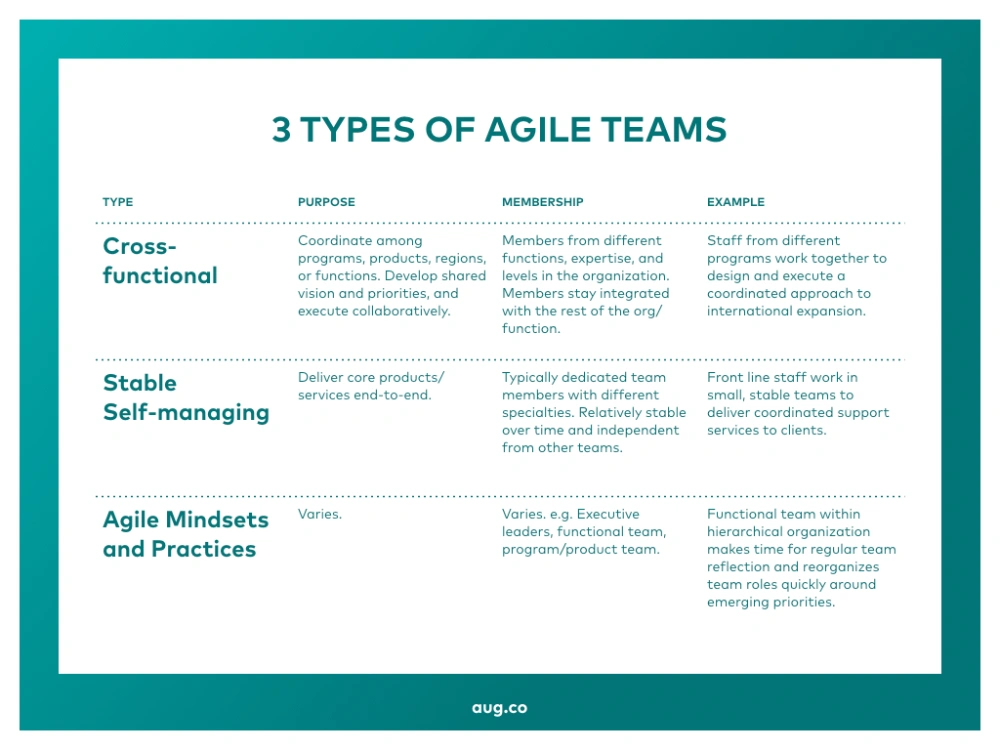
Cross-functional teams
Agile teams are typically cross-functional, meaning they include members with different skill sets and expertise. This allows the team to work together more efficiently and effectively, and to quickly adapt to changes in project requirements. Organizations may need to restructure their teams to create more cross-functional teams.
Self-organizing teams
Agile teams are also self-organizing, meaning they have the autonomy to make decisions about how they work and how they allocate their resources. This can help teams to be more responsive to changes in project requirements, and to work more efficiently. Organizations may need to give their teams more autonomy and support them in becoming self-organizing.
Smaller teams
Agile teams are typically smaller than traditional project teams, which can help to improve communication and collaboration within the team. Organizations may need to reduce the size of their teams to enable them to work more effectively in an agile environment.
Flexible team composition
Agile teams are often composed of members who can be added or removed as needed, depending on the requirements of the project. This allows teams to quickly adapt to changes in project requirements and to work more efficiently. Organizations may need to create a flexible team composition model to support this approach.
Agile coaches
Organizations may need to hire agile coaches or consultants to support their teams in adopting an agile approach. These coaches can provide guidance on agile methodologies, help teams to identify areas for improvement, and support the organization in making necessary changes to their team structure or organization design.
Overall, the changes that organizations make to their team structure or organization design during agile project iterations are intended to support greater flexibility, collaboration, and efficiency, and to enable teams to respond quickly to changes in project requirements.
product-aligned & capability-aligned
two dominant approaches to organizing teams in modern organizations, both approaches have trade-offs and can be combined for best effect:
Product-aligned teams are organized around specific individual products, giving them autonomy and end-to-end ownership but leading to suboptimal business outcomes, cost inefficiencies, and data silos.
Capability-aligned teams are organized around common services/features/functionality used in many or all of the company’s products. Allowing for powerful internal ecosystems, joined-up customer experiences, and rich data analysis but requiring higher coordination and potentially complicated funding.
the trade-offs:
-
including decision-making autonomy
-
end-to-end technical ownership
-
financial self-sufficiency
-
reduced organizational politics
-
innovation speed
-
optimized user experience
-
sub-optimal business outcomes
-
cost-inefficiencies
-
high opportunity costs
-
neglected non-core sub-capabilities
-
poor overall user experience
-
data silos
-
lack of cross-pollination
-
powerful internal ecosystems
-
deep 3rd party integrations
-
joined-up customer experiences
-
cost-efficiency
-
rich data analysis
-
deep innovation
-
flatter structure
-
higher-coordination at the program level
-
reduced autonomy and speed
-
complicated funding
-
lack of customer perspective
-
selfish silos
-
empire building
-
overly-complex generic capabilities that suit nobody
-
ecosystem overhead
-
and hard convincing internal customers to use the capability.
-
1 Business Owner
-
2-5 Cofounders / Business Partners
-
6-10 Scrum Team
-
11-25
-
26-50
Group Development
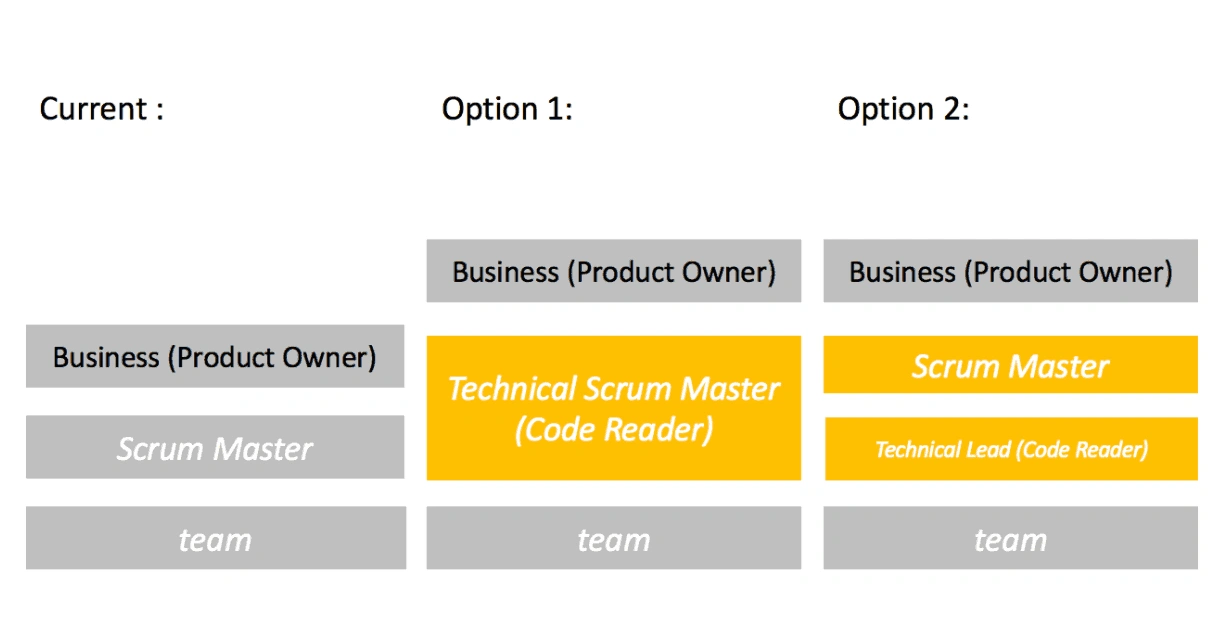
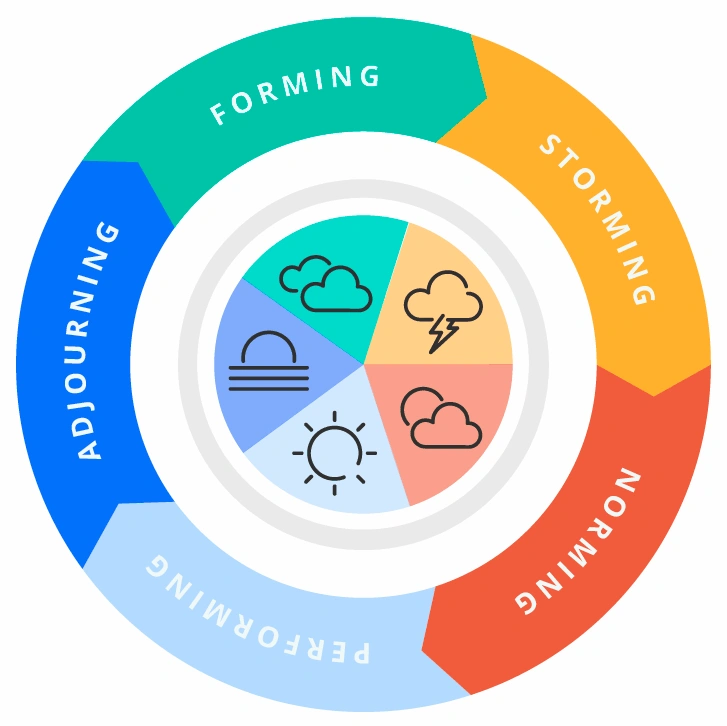
Forming The team meets and learns about the opportunities and challenges, and then agrees on goals and begins to tackle the tasks. Team members tend to behave quite independently. They may be motivated but are usually relatively uninformed of the issues and objectives of the team. Team members are usually on their best behavior but very focused on themselves. Mature team members begin to model appropriate behavior even at this early phase. The meeting environment also plays an important role to model the initial behavior of each individual. The major task functions also concern orientation. Members attempt to become oriented to the tasks as well as to one another. Discussion centers on defining the scope of the task, how to approach it, and similar concerns. To grow from this stage to the next, each member must relinquish the comfort of non-threatening topics and risk the possibility of conflict.
Web Call Tools
 \
\
Teamwork
Yes, "There's no I in Team" can be a harmful platitude. While it emphasizes the importance of teamwork and collaboration, it can also overlook the value of individual contributions and unique perspectives. Here are some reasons why it's problematic:
- Negates individuality: It suggests that individual identity and contributions should be suppressed in favor of group harmony.
- Discourages constructive conflict: It can create a culture of conformity, preventing healthy debate and the exchange of diverse ideas.
- Oversimplifies teamwork: Teamwork is more than just avoiding conflict; it involves effective communication, mutual respect, and the ability to leverage individual strengths.
A more balanced perspective might be: "Great teams value both collaboration and individual contributions." This acknowledges the importance of teamwork while recognizing that the strength of a team often lies in the diversity and unique talents of its members.