Productivity
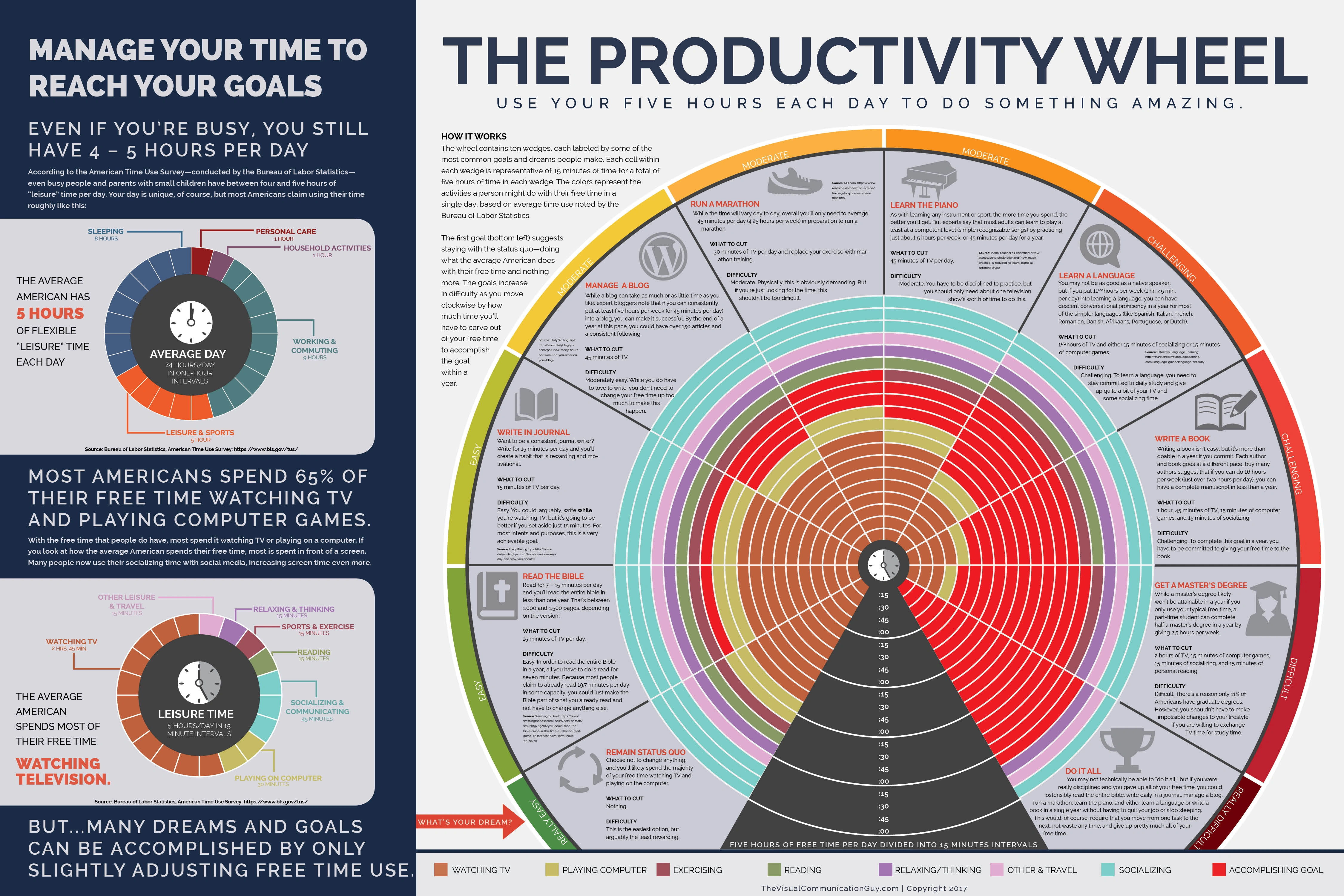
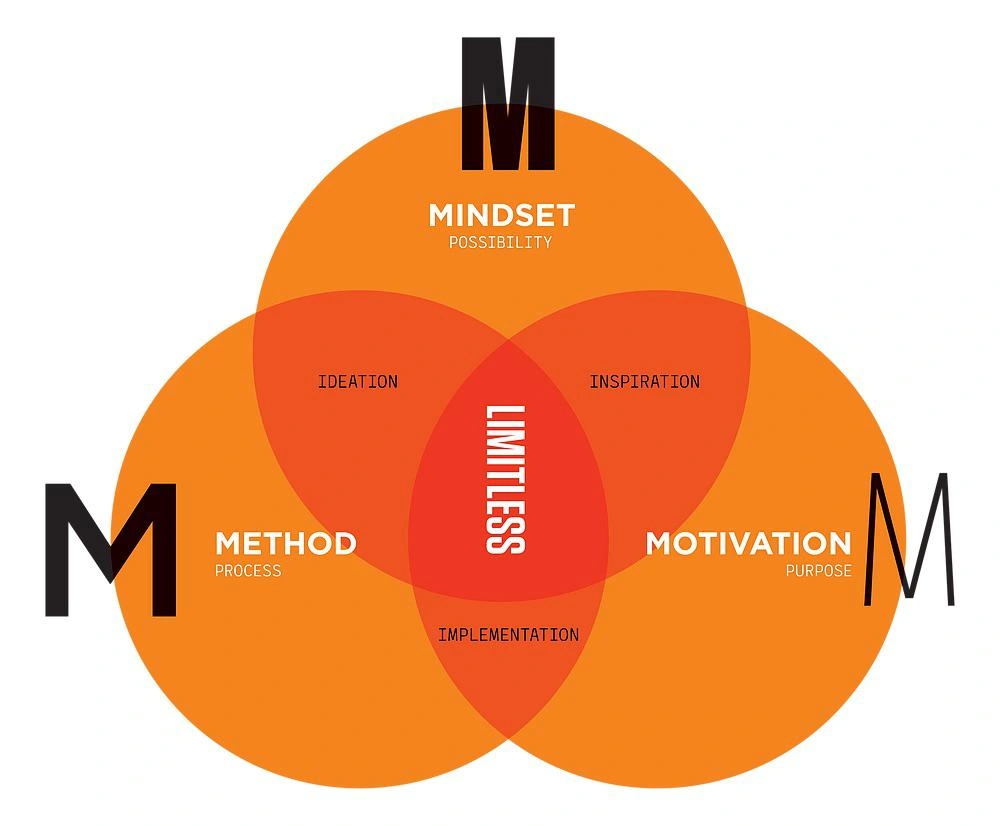
The Productivity Wheel
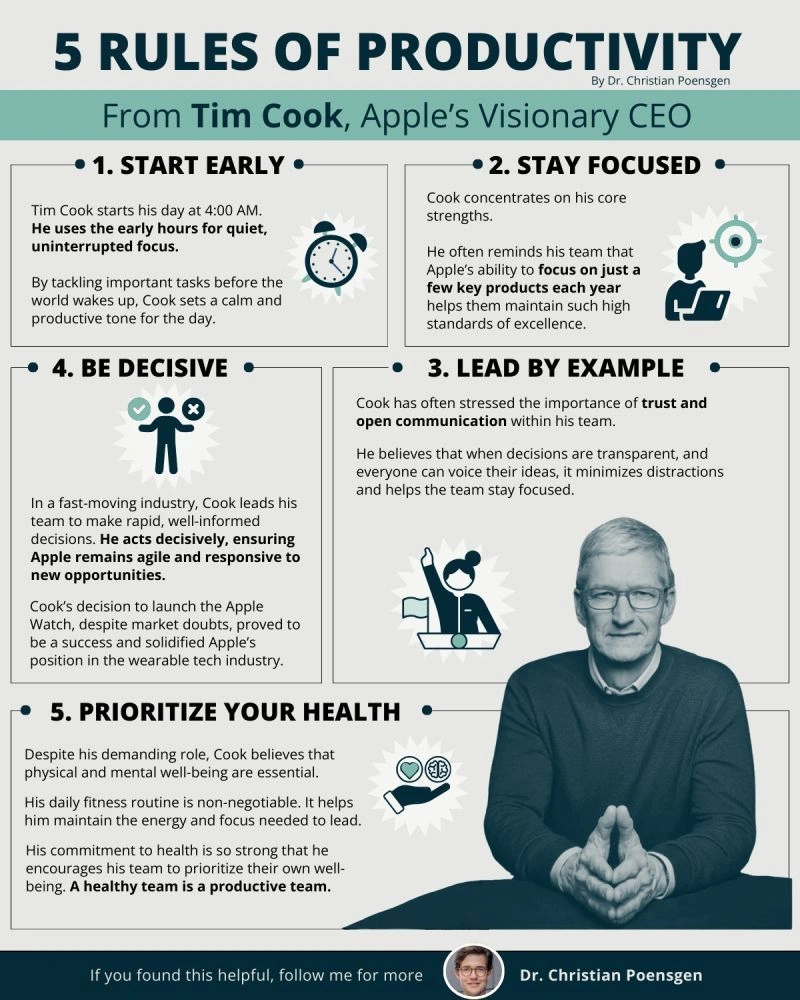
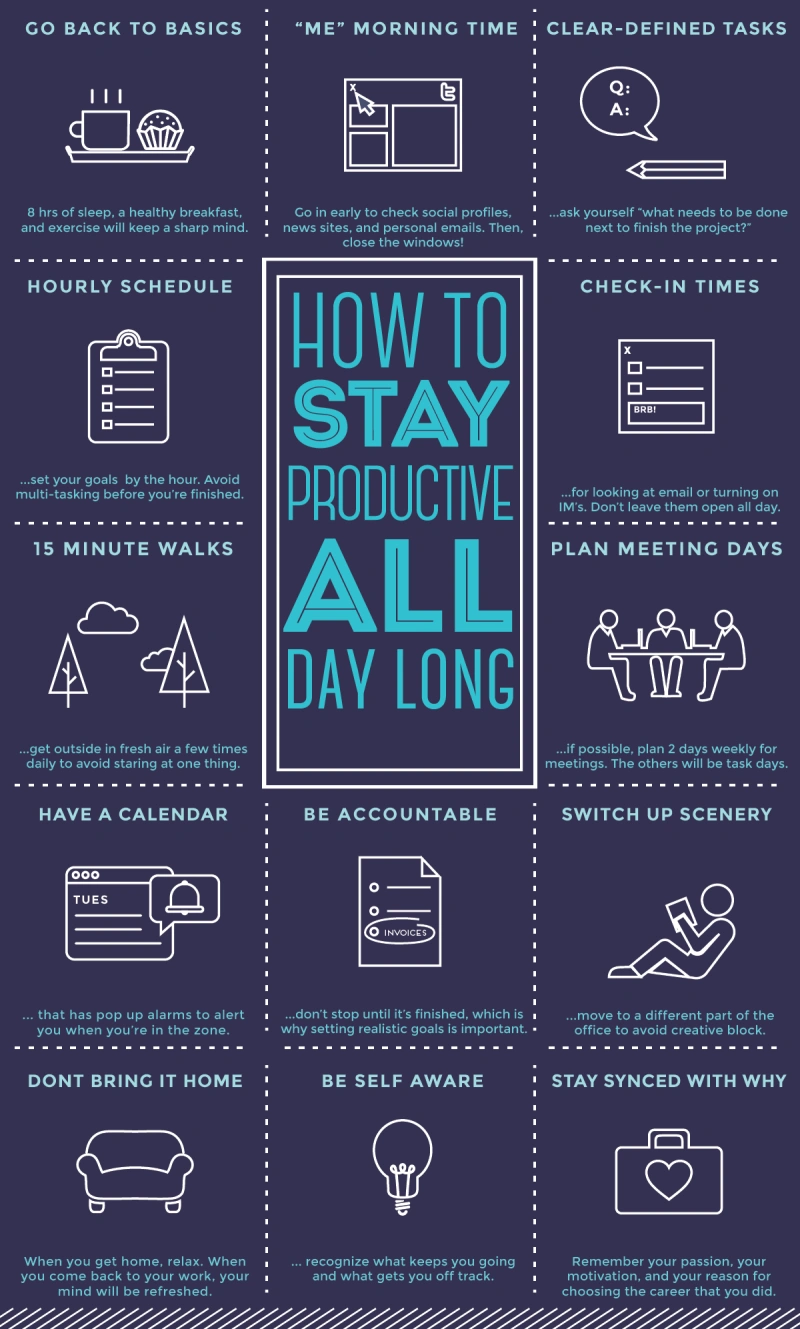
Do the hardest task in the morning
if you are a morning person. if you're peak focus time is afternoon/evening, start with an easy task for a quick win.
The rest of the day feels a lot easier
Focus On Learning and Creating Rather Than Entertainment and Distraction
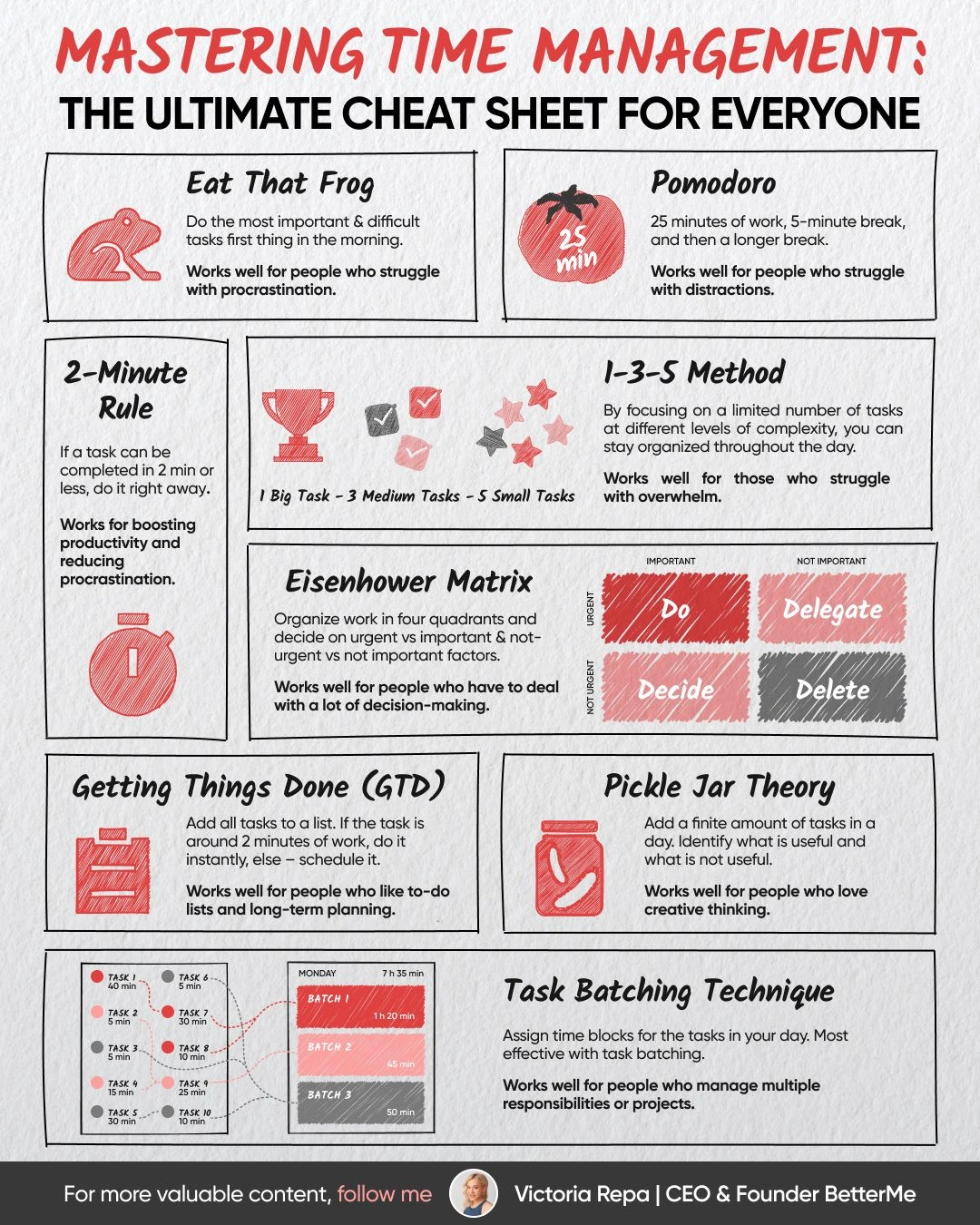
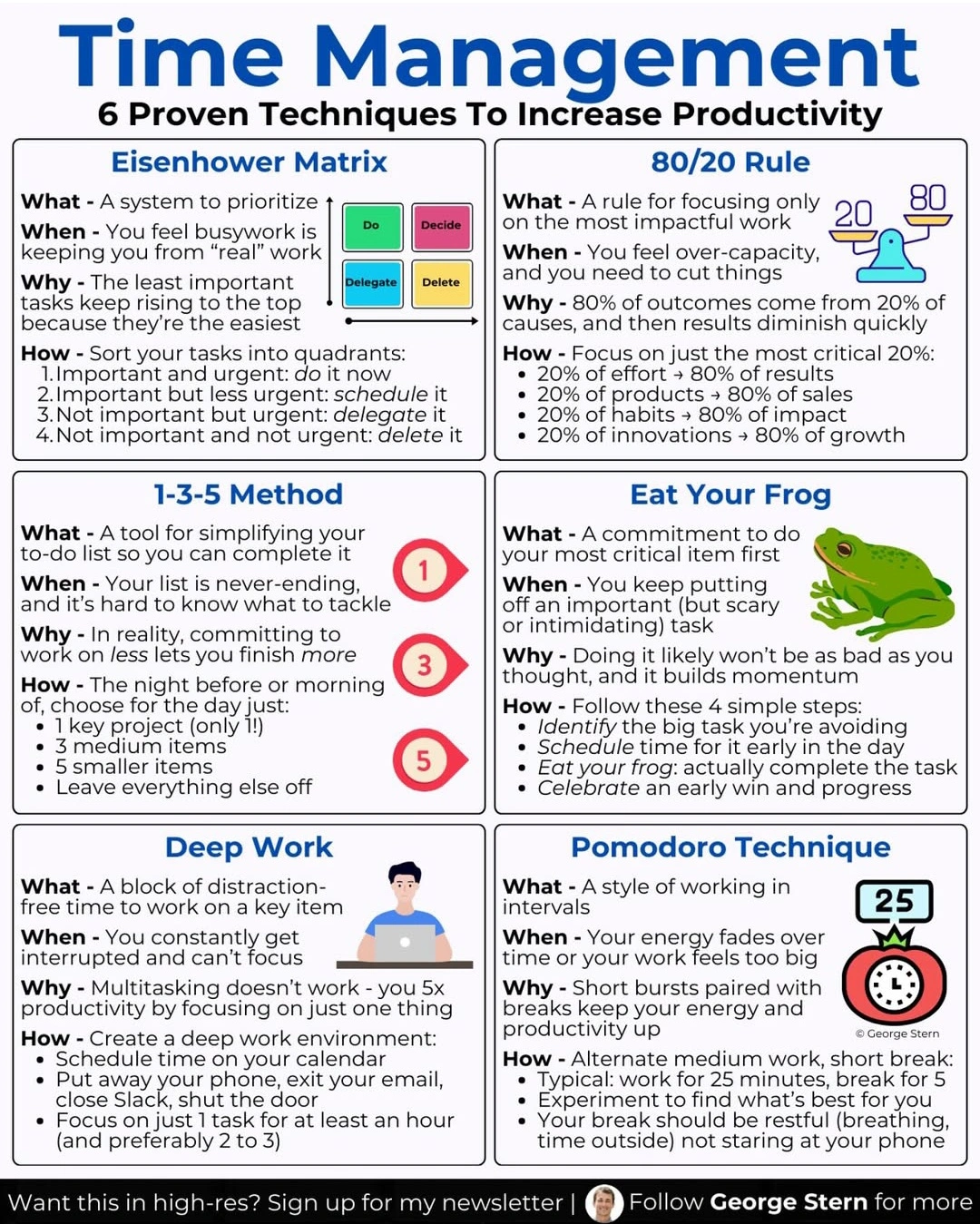
Pomodoro
The Pomodoro Technique is a time management method that uses focused work intervals (typically 25 minutes) followed by short breaks. Here are helpful resources:
- Life at.io
- Pomodoro Tracker
- Pomo.work
- Pomodoro Timer Online
- Tomato Timers
- Productive Club - Pomodoro Technique
- Pomodor App Timer
Additional Resources:
- Nesto.cc - Focus and productivity tools
- Focus on This Podcast - Episode 171: 3 Steps to Stop Holding Yourself Back
- Michael Hyatt Full Focus Assessments
- Huberman Lab: How to Increase Your Willpower & Tenacity
- Full Focus Life Score Assessment
- LotNet SEM
- Business Accelerator - Start with a List
- Next Evolution Performance - Optimal Focus Time for Maximum Productivity
Batching is a productivity technique that involves grouping similar tasks together and completing them in a single focused effort. While it is commonly associated with physical tasks, it can also be applied to the workflow of software engineers to enhance productivity and efficiency. Here are a few ways software engineers can leverage batching:
-
Bug fixing and issue resolution: Instead of addressing bugs and issues as they arise throughout the day, allocate specific time blocks for bug fixing. By batching similar tasks together, you can minimize context switching and maintain focus on resolving multiple issues at once. This approach allows you to dive deep into the codebase, identify patterns, and apply fixes more effectively.
-
Code reviews: Instead of reviewing code changes as they are submitted, schedule specific time slots for code reviews. This batching approach allows you to focus solely on reviewing code, ensuring thoroughness and consistency in your evaluations. It also helps the development team by providing prompt and concentrated feedback.
-
Documentation and knowledge sharing: Dedicate specific time blocks to document your code, write technical documentation, or contribute to internal knowledge sharing platforms. Batching these tasks allows you to consolidate your thoughts, streamline the documentation process, and reduce interruptions from other development activities.
-
Feature development: Group similar feature development tasks together and work on them in a concentrated manner. By focusing on a specific feature or functionality for a dedicated period, you can maintain better momentum and make progress more efficiently. This approach minimizes the time lost due to context switching between different features or tasks.
-
Meetings and communication: Rather than having scattered meetings throughout the day, try to batch them together in specific time slots. This practice helps you to protect uninterrupted blocks of time for deep work and minimizes the disruption caused by frequent context switching.
-
Testing and quality assurance: Plan testing activities and quality assurance efforts as dedicated batches. Instead of testing individual features or changes as they are completed, allocate specific time blocks to thoroughly test multiple features or changes together. This approach can help identify interdependencies and integration issues more effectively.
Remember, while batching can enhance productivity, it's important to strike a balance. Some tasks may require immediate attention or have dependencies that cannot be batched. Flexibility is key in optimizing your workflow. Experiment with different batching strategies and adjust them based on your specific work environment and personal preferences.
Anticipatory stress
Anticipatory stress refers to the anxiety or tension experienced by workers in anticipation of future events, tasks, or situations related to their work. It is a psychological response that occurs before the actual occurrence of the stressor. In terms of worker productivity, anticipatory stress can have both positive and negative effects:
- Negative impact on productivity: Anticipatory stress can be detrimental to worker productivity in several ways. When individuals experience high levels of stress and anxiety about upcoming work-related events or tasks, it can impair their ability to concentrate, make decisions, and perform at their best. It may lead to feelings of overwhelm, decreased motivation, and difficulty in managing workload effectively. This can result in decreased productivity and quality of work.
-
Procrastination and avoidance: Anticipatory stress can sometimes lead to procrastination and avoidance behavior. Workers may delay starting or completing tasks due to the fear or anxiety associated with the anticipated stressor. This can further exacerbate productivity issues as deadlines approach and work piles up.
-
Impaired focus and attention: When workers are preoccupied with anticipatory stress, their ability to concentrate and stay focused on their current tasks may be compromised. Their minds may be consumed with thoughts and worries about future events, making it challenging to be fully present and productive in the moment.
-
Reduced creativity and problem-solving ability: High levels of anticipatory stress can hinder creative thinking and problem-solving skills. Stress can narrow focus and limit cognitive flexibility, making it difficult to generate innovative ideas or find effective solutions to challenges.
-
Positive impact with moderate levels of stress: While excessive anticipatory stress can be detrimental, moderate levels of stress can actually enhance productivity for some individuals. A certain amount of stress can act as a motivational factor, driving individuals to prepare, plan, and perform at their best. It can increase alertness, energy, and focus, leading to improved performance and productivity.
To mitigate the negative impact of anticipatory stress on worker productivity, organizations can implement strategies like providing clear communication, setting realistic expectations, offering support and resources, encouraging work-life balance, and promoting stress management techniques such as mindfulness or relaxation exercises. Additionally, individuals can adopt practices such as effective time management, prioritization, and seeking social support to better cope with anticipatory stress and maintain productivity.
Mindfulness
- burnout
- rust-out | being underutilized, monotonous work, not meaningful. only 21% of people feel engaged at their jobs globally.
Quotables
-
pessimism leads to weakness, optimism leads to power
-
motivation precedes action and procrastination precedes guilt
Badass Quotes Andy Grove, CEO of Intel
-
"Only the paranoid survive." This quote is often used to emphasize the importance of being vigilant and proactive in business, and not becoming complacent or overconfident.
-
"Bad companies are destroyed by crisis. Good companies survive them. Great companies are improved by them." This quote emphasizes the importance of resilience and adaptability in business, and the potential for crises to drive innovation and improvement.
-
"Success breeds complacency. Complacency breeds failure. Only the paranoid survive." This quote is similar to the first one, emphasizing the importance of staying vigilant and proactive even in the face of success.
-
"In technology, whatever can be done will be done." This quote reflects Grove's belief in the power of innovation and the potential for technology to transform industries and societies.
-
"Leadership is not about being in charge. It's about taking care of those in your charge." This quote emphasizes the importance of servant leadership and putting the needs of others before your own in order to build a strong and successful team.
-
You’re a boat with holes
Deal with yourself Fix your your holes before you ask others to step on board
- "Stress comes from ignoring things that you shouldn't be ignoring.
- Be stubborn on vision, but flexible on details.
- fail fast and often
- you can’t be married to the product, you have to be married to the sales
- The biggest risk is not taking any risk - Zuck
- Where focus goes, energy flows - Tony Robbins
“Don’t wish it were easier, wish you were better.” – Jim Rohn
“Change your thoughts and you change your world.” – Norman Vincent Peale
“A ship in harbor is safe, but that is not what ships are built for.” – John A. Shedd
“Do today what others won’t and achieve tomorrow what others can’t.” – Jerry Rice
“Either write something worth reading or do something worth writing.” – Benjamin Franklin
“The three most harmful addictions are heroin, carbohydrates, and a monthly salary.” – Nassim Nicholas Taleb
"Learn to love the process, not just the outcome." Bet-David often emphasizes the importance of enjoying the journey, rather than just focusing on the end goal. He believes that when you love the process of building a business or achieving a goal, you are more likely to stick with it and ultimately succeed. Patrick Bet-David
"Take massive action." Bet-David is a big advocate of taking bold, decisive action in pursuit of your goals. He believes that taking massive action is the key to achieving success, and that it's better to take imperfect action than to wait for everything to be perfect before you start. Patrick Bet-David
"Be willing to fail." Bet-David encourages entrepreneurs to embrace failure as a necessary part of the learning process. He believes that failure is inevitable on the road to success, and that the most successful people are those who are willing to take risks and learn from their mistakes. Patrick Bet-David
"Surround yourself with the right people." Bet-David believes that the people you surround yourself with have a huge impact on your success. He advises entrepreneurs to seek out mentors and surround themselves with people who are supportive and who can help them grow. Patrick Bet-David
"Focus on solving problems." Bet-David believes that the most successful businesses are those that solve real problems for their customers. He advises entrepreneurs to focus on identifying and solving problems in their industry, rather than just chasing after the latest trends or fads. Patrick Bet-David
“Don’t wish it were easier, wish you were better.” – Jim Rohn
“Change your thoughts and you change your world.” – Norman Vincent Peale
“A ship in harbor is safe, but that is not what ships are built for.” – John A. Shedd
“Do today what others won’t and achieve tomorrow what others can’t.” – Jerry Rice
“Either write something worth reading or do something worth writing.” – Benjamin Franklin
“The three most harmful addictions are heroin, carbohydrates, and a monthly salary.” – Nassim Nicholas Taleb
440 BCE, the Greek physician Hippocrates said, “Let food be thy medicine and let thy medicine be food.”
Burnout

Holistic Approach
- Sleep
- Stress
- Anxiety
- Burnout
- Emotions
- Resilience
- Priorities
- Values
- Identity
- Beliefs
- Success
- Work & Life
- Communication
Procrastination
avoidant strategy
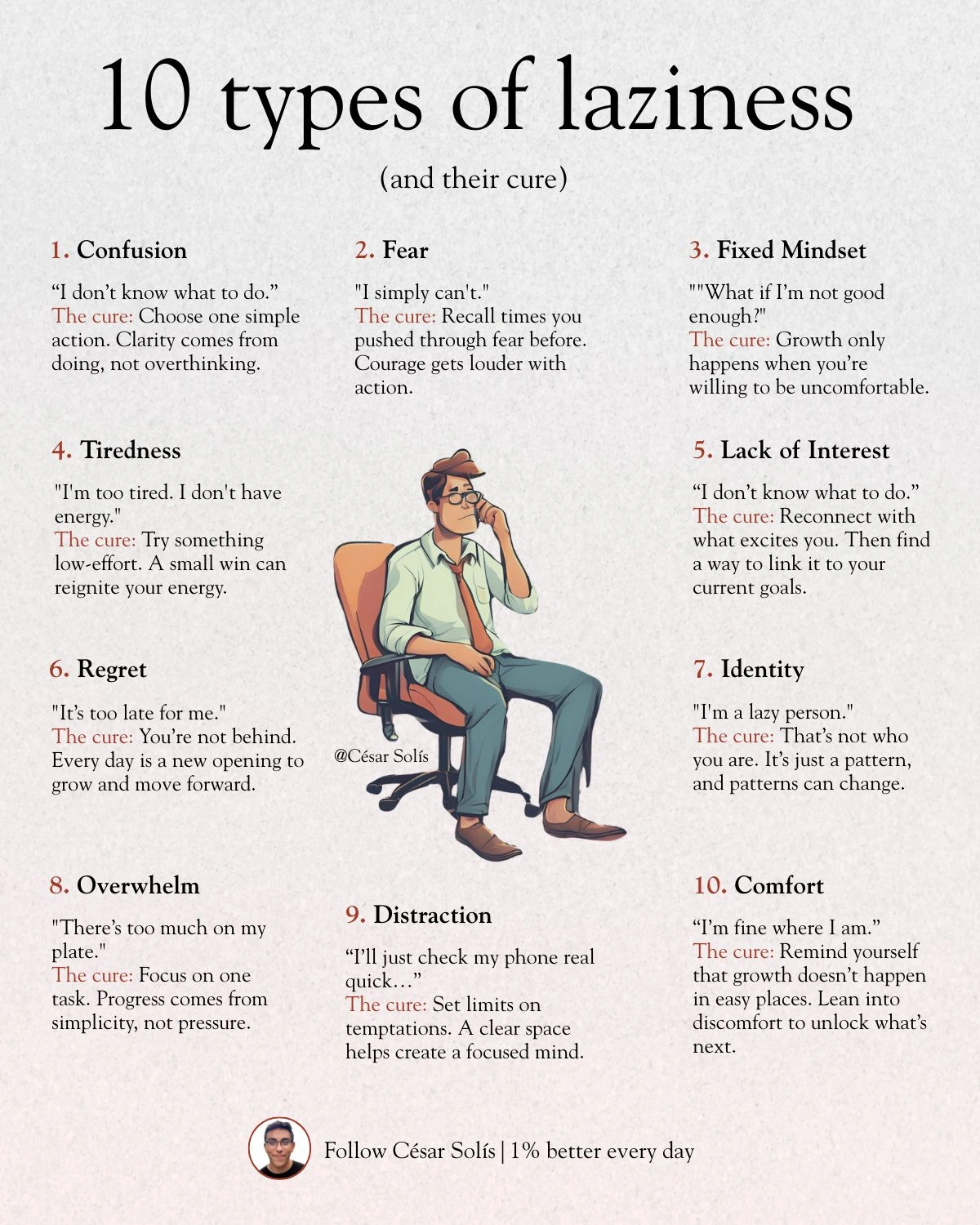
An "avoidant strategy" in the context of productivity is a behavior or thought pattern used to evade tasks, responsibilities, or situations that are perceived as difficult, stressful, or uncomfortable. This is a form of procrastination, but it goes deeper than simply putting things off. It's often rooted in a desire to avoid negative feelings like anxiety, fear of failure, or criticism.
when facing tasks that are complex, emotionally draining, or require a lot of concentration
Here are some common examples of avoidant strategies:
- Procrastination: This is the most obvious form. It involves delaying a task until the last minute or past its deadline. For example, delaying writing code for a complex feature or putting off a difficult client call.
- Substituting tasks: This is when you busy yourself with trivial, low-priority tasks to avoid a more important or challenging one. For instance, cleaning your entire workspace or reorganizing files instead of tackling a major project.
- Distraction: Engaging in unrelated activities to escape a task. This could be endlessly scrolling through social media, watching videos, or getting lost in non-essential emails.
- Over-planning: Spending excessive time on planning, research, or organizing to avoid starting the actual work. You might create detailed Gantt charts or elaborate design mockups, but never actually begin the development phase.
- "Busyness" as a shield: Taking on a lot of small, easy tasks to appear productive, while avoiding the one or two critical tasks that would truly move the business forward.
How it impacts productivity and your agile processes
From a productivity and agile standpoint (like SCRUM or SAFe), an avoidant strategy can be particularly damaging:
- Hindered progress: It creates backlogs and delays, preventing you from completing sprints and reaching your goals.
- Increased stress: While avoidance provides temporary relief, it often leads to increased anxiety and a feeling of being overwhelmed as tasks pile up.
- Decreased quality: Rushed, last-minute work is often lower quality, leading to more bugs, poor user experience, or a less effective marketing campaign.
- Impedes teamwork: When a team member avoids a task, it can create bottlenecks and prevent others from moving forward, impacting the entire sprint team's velocity.
- Stifles growth: Avoiding difficult tasks or feedback prevents you and your team from learning new skills and improving.
Overcoming Avoidant Strategies
To combat these behaviors, you can apply some of the same principles you use in your agile methodology:
- Break Down Tasks: A large, daunting task is often a trigger for avoidance. Break it down into smaller, more manageable sub-tasks. This is a core part of agile. For example, instead of a user story that says "Develop a new e-commerce app," break it down into smaller, actionable items like "Create a wireframe for the product page," "Set up the database for user accounts," and so on.
- Use a "Timebox": Just as SCRUM uses timeboxed sprints, you can timebox your work. Use techniques like the Pomodoro Technique (e.g., 25 minutes of focused work, 5-minute break) to make a difficult task feel less overwhelming.
- Practice Self-Compassion: Recognize that avoidance is often a coping mechanism for stress or fear. Instead of beating yourself up, acknowledge the feeling and then refocus on a small, achievable step.
- Embrace the "Two-Minute Rule": If a task takes less than two minutes, do it immediately. This prevents small, easy tasks from piling up and becoming a source of stress and avoidance.
- Address the "Why": For you and your team, it's important to understand the root cause of the avoidance. Is a task unclear? Is someone lacking the necessary skills? Is it a fear of criticism? Identifying the "why" allows you to solve the actual problem instead of just treating the symptom.
say no
How to master the art of saying "No" at work.
How are we supposed to say No, or defend tasks delegated to us in real life when we are expected to be kind and social all the time?
Good question!
Situations We've All Been in at Work
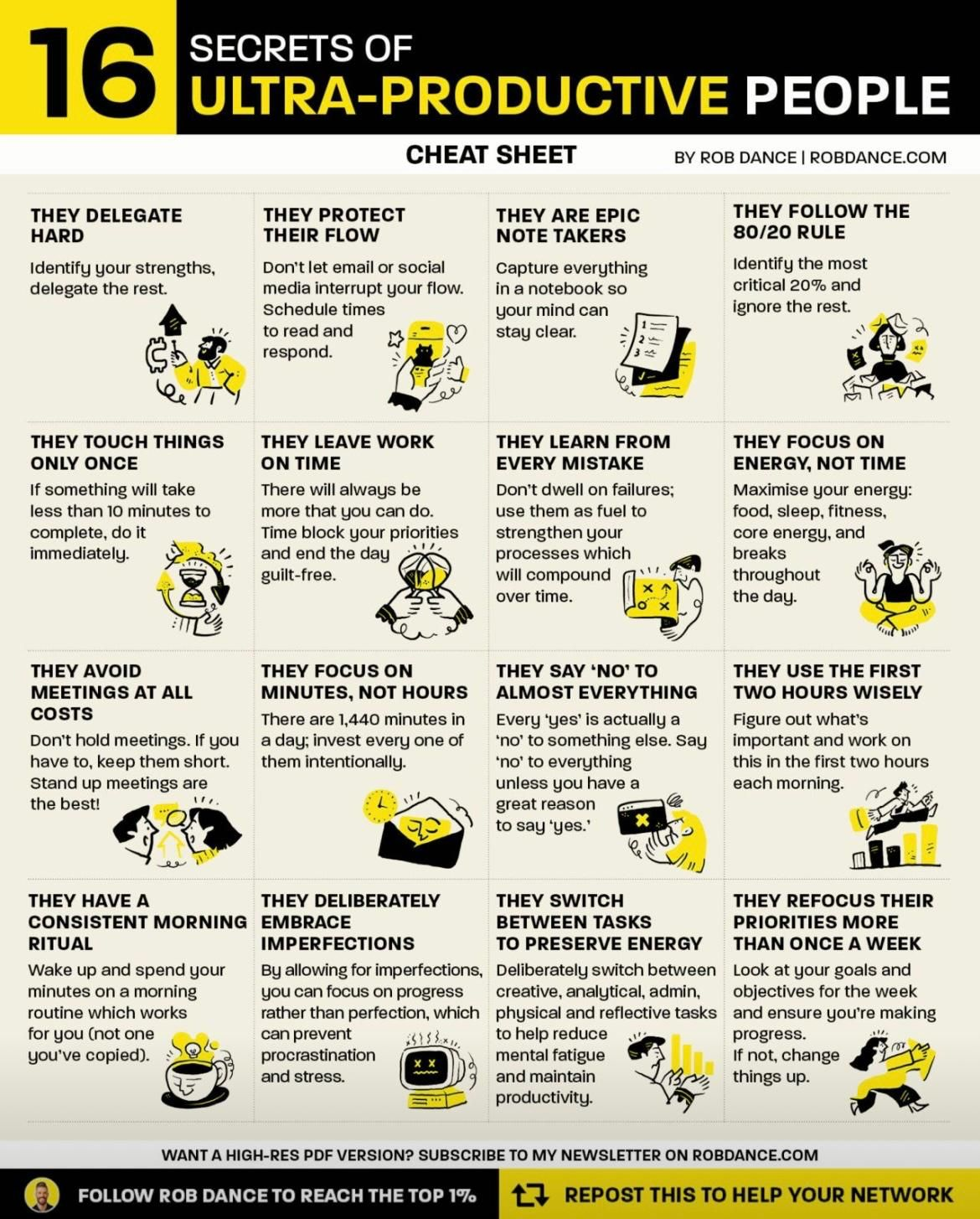
Delegate, the third quadrant, is for those tasks you could delegate because they are less important to you but still pretty urgent to others. Needless to say, this quadrant is my second favorite right after Don't Do … ;)
But these tasks don’t always start on your to-do list. A popular example of a task to be delegated could also be a colleague calling you to ask for urgent help on finishing a report. Instead of giving in right there, you could quickly share all necessary information (like templates or links) with the caller so that they can deal with the matter on their own—this delegates the task "back to the sender."
As I said, my personal favorite is the fourth and last quadrant – Don’t Do – because it is there to help you sort out things you should not be doing at all.
Sometimes these take the form of individual tasks, but other times they might be habits you’ve created. Discovering and stopping bad habits is especially tough—like a routine you might have of neglecting your family for another after-work beer or two with your coworkers. This is a habit you should sometimes say no to (even though it might not be easy) so that you can get home quickly to invest your time in helping your kids grow up.
Saying No is Tough, but You Have to Do It from Time to Time
I'll admit it, most of us don't like to say No. We want to be nice, and we don't want to jeopardize our relationships. While saying Yes seems like an easier answer, it’s rarely the best one to live with all the time.
And saying No is okay, sometimes even totally fine with the other person. Don't think you are rude, evil or that the other person will have bad feelings. Often such fears are irrational or unfounded. Besides, if the person doesn’t understand a reasonable No, maybe they are not a person you want to spend much of your life with anyway.
Still uneasy? Let me assure you, most of the times I said No, nothing bad happened. People around the world experience this every day. In my case, the other person was sometimes even happy that I was so upfront. Many times the relationship became stronger from it, and I gained respect for being able to set a clear boundary.
Tactics to Try When Being Approached by Others
When contacted by others with their priorities, start by showing some empathy: "I totally feel you. I would love to help you, but …" Then try picking out of the responses below and just keep the following rules in mind:
Don't rush into responding, but first, consider the consequences of giving in versus the benefits of refusal - both professionally and personally. Don't let the other person wait too long for a No or the social obligation will grow too quickly while the other person is relying on you to give in and might run into serious problems without alternatives if you eventually don't. Don't let the other person talk or charm you into something, it’s best to make a No decision before sharing it with the other person and stick to it no matter what. Sometimes remembering your alternative task or scenario that is in danger of being pushed aside and putting the newly offered task in relation to your vision and Why might make you stronger. Keep your response brief, to the point, and avoid too many details that the other side could question. Don't ever start arguing when the other person questions your reasons, but rather stay with your initial decision—repeat your reasons and the decision itself if you need to, then end the conversation. In some instances where no explanation is absolutely required, it may be better not to share one. How I Gained Back Control of My Yes and No
Let me give you a list of things to try when your boss or (more often) a colleague approaches you to dump another task:
Defensive strategies (the usual No)
Unavailable to talk: I am in the middle of something right now. Can we talk some other time? (With this you are taking a bet that somebody else will step forward in the meantime.) Unavailable for the task: I am definitely unavailable for this due to another important task I need to finish by the end of tomorrow. Schedule conflict: It’s very kind that you thought of me, but my schedule is completely booked today. Professional conflict: I wish I could, but Martin told me not to start anything else before I finish this. Personal conflict: I am flattered that you approached me, but I am unable to take this on because I have agreed to pick up the kids today. Value conflict: I am very sorry, but I have chosen not to work on any client opportunity in this industry. Decision already made: I know I am disappointing you, but I've already decided not to volunteer this time because I feel I'll end up with too little time for my personal priorities.
Discipline
Scheduling
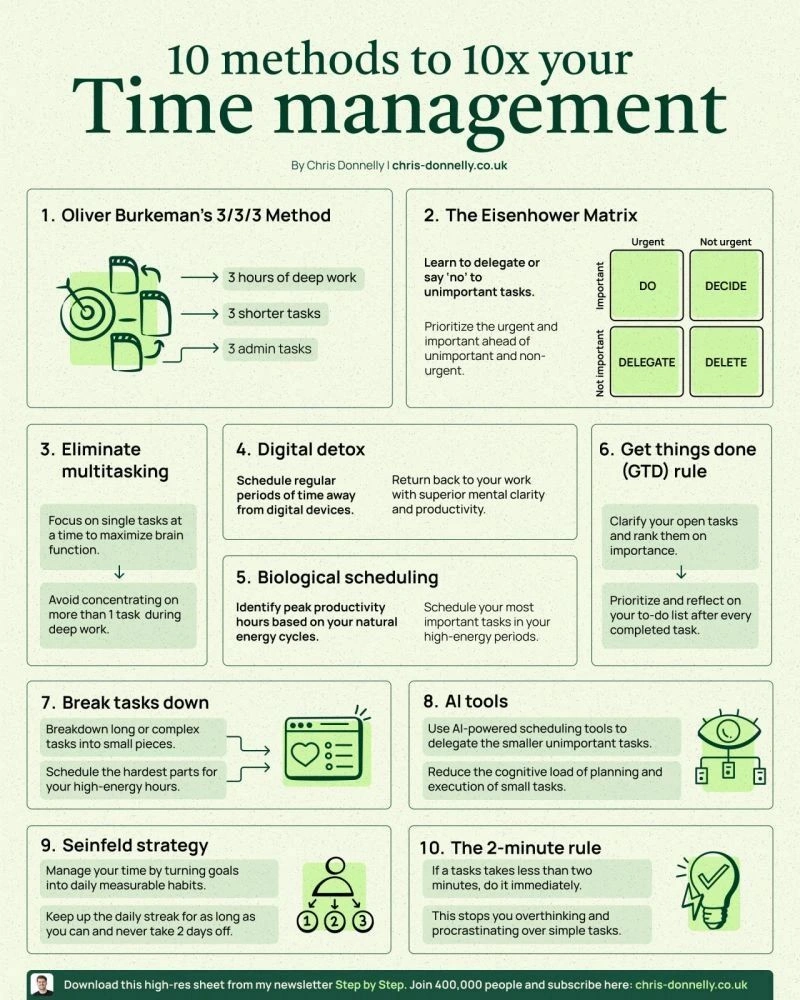
Time Blocking
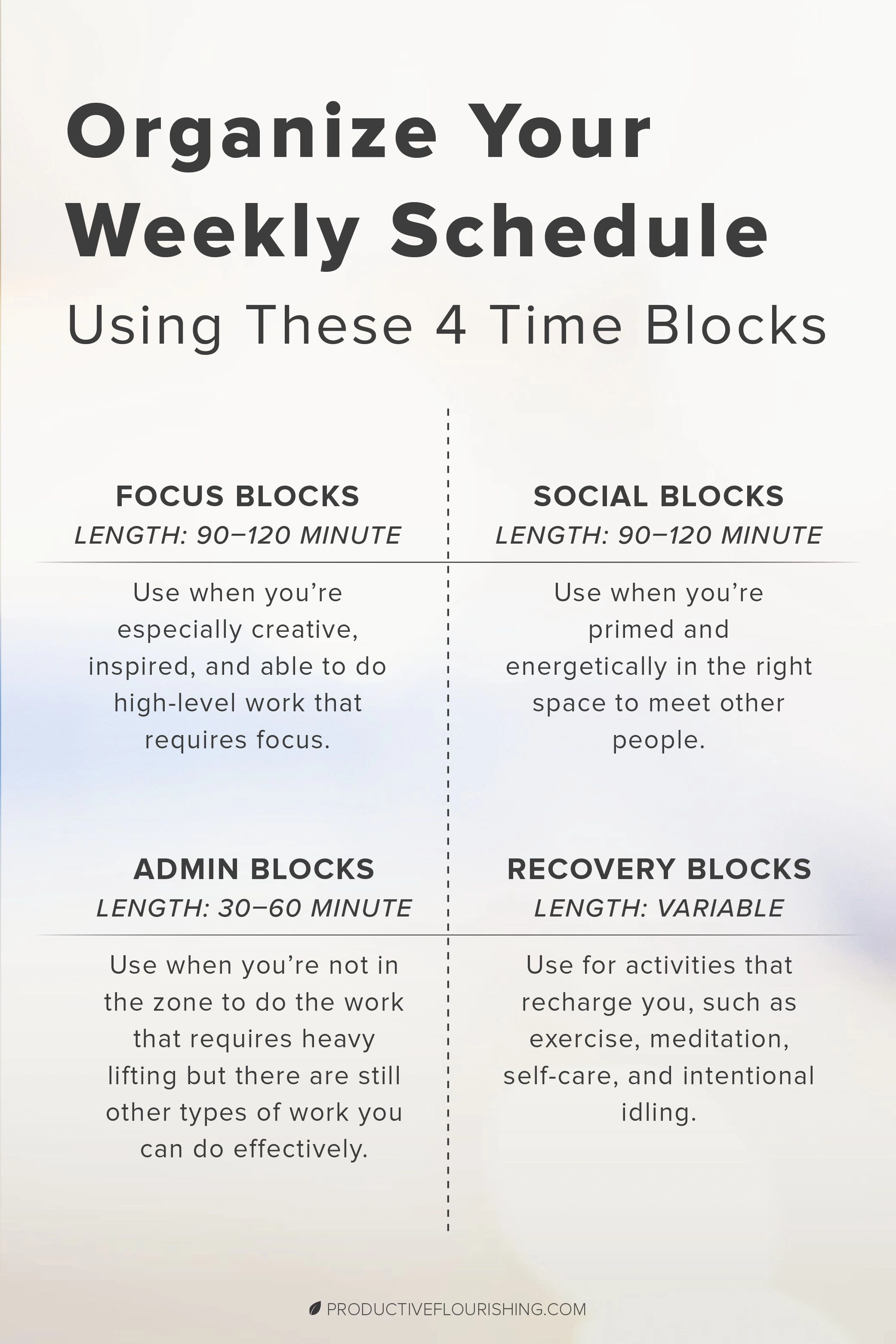
working with full focus for 52 minutes followed by a 17-minute break
2 min rule
if a task arises that can be done in two minutes or less, it should be done immediately
Time Boxing
Timeboxing is a time management method where you allocate a fixed period, or box, to complete a specific task or set of tasks before moving on.
Eisenhower Matrix
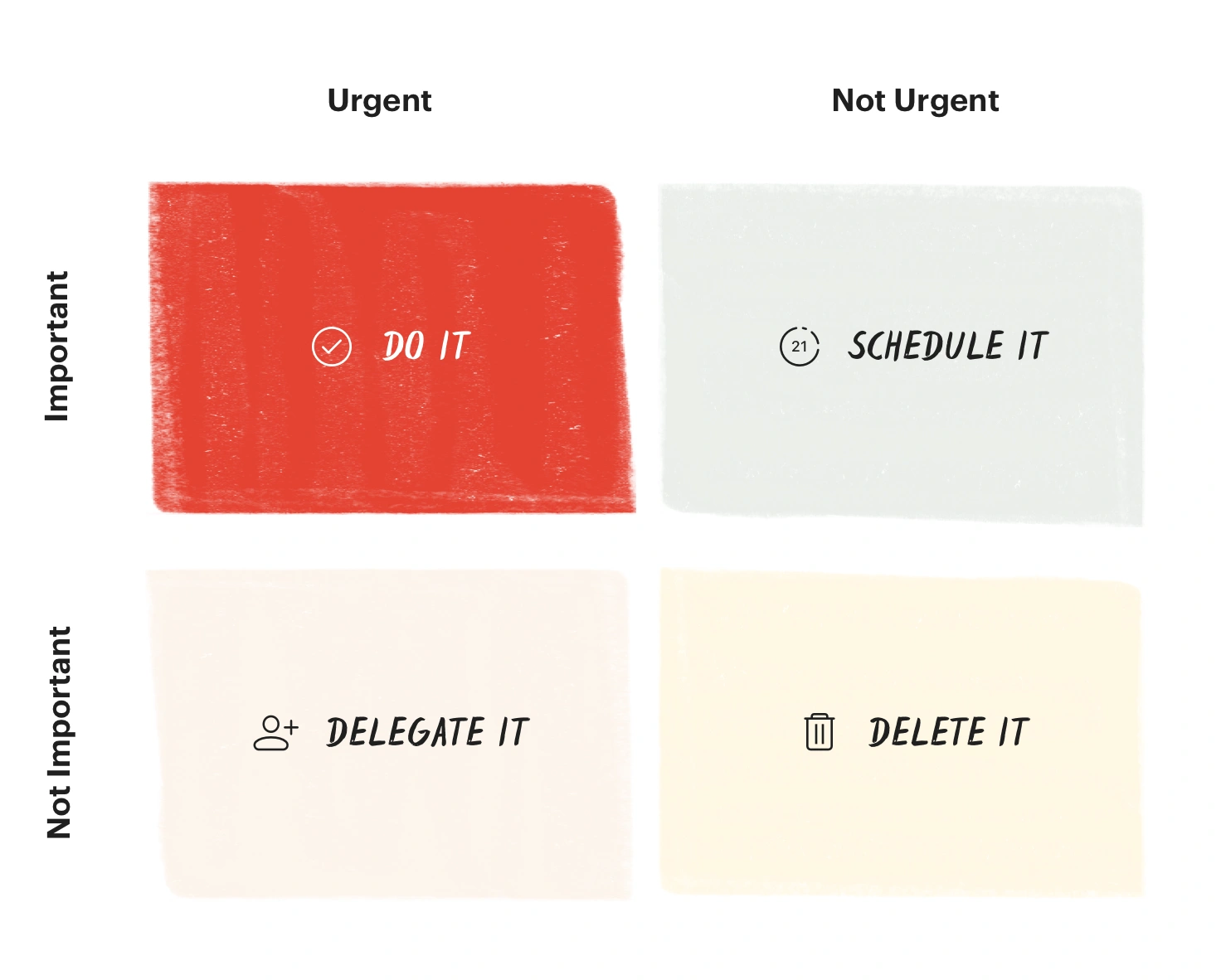
This framework helps prioritize tasks by urgency and importance.
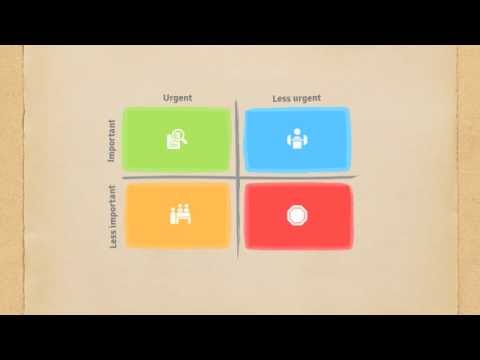
- Q1: Do First (Urgent and Important): Crises, deadlines, and problems.
- Q2: Schedule (Important, Not Urgent): Planning, prevention, and relationship building.
- Q3: Delegate (Urgent, Not Important): Interruptions and low-leverage urgent tasks.
- Q4: Don't Do (Not Urgent and Not Important): Trivia and time wasters.
Time Management
Time Audit
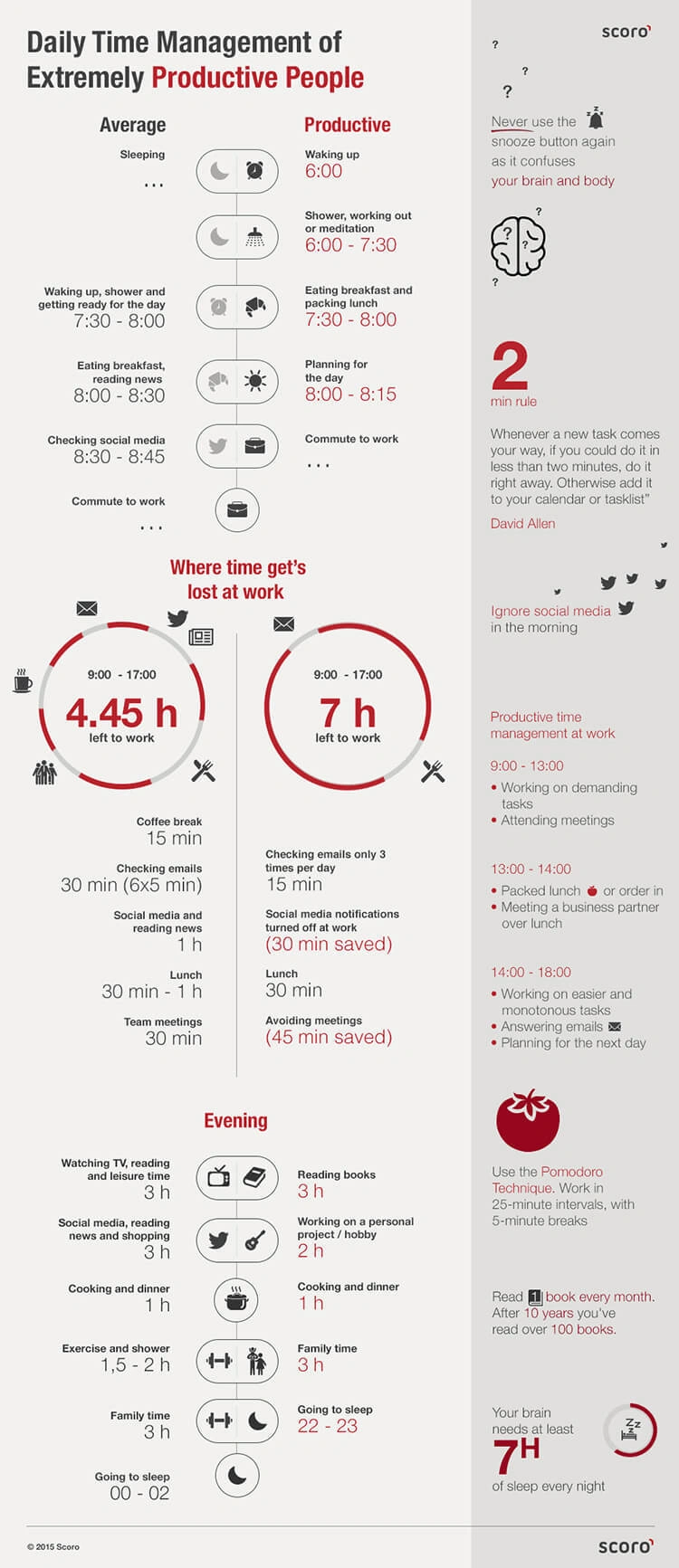
- identify your current time usage to help understand where you can make critical adjustments
- note down your energy levels throughout the day in order to schedule your most important tasks during your energy peaks
- find your optimal focus chunk
Ultradian Rhythms
Ultradian rhythms are recurring cycles through the day (often around 90 minutes) that influence focus and energy.

 Done that already: I really enjoyed helping you in the past, but I can't make it this time. This week is already too packed.
No response at all: Sometimes, no response, especially with e-mails, is also interpreted as a No (even if that might not always be feasible and is definitely not a long-term strategy).
Done that already: I really enjoyed helping you in the past, but I can't make it this time. This week is already too packed.
No response at all: Sometimes, no response, especially with e-mails, is also interpreted as a No (even if that might not always be feasible and is definitely not a long-term strategy).
Offensive strategies (the unexpected No)
Redirect to sender: Have you seen this information over here? I recommend you try it yourself, it is really easy! Redirect to others: I think Sue did something very similar in the past. Have you asked her already? Change the game: I really don't want to do that, but thank you so much. Why don't we work together on that other project instead? Change the playing field: I haven’t yet thought about that yet, but now that you’re approaching me with this, it’s given me the chance to try an entirely different approach I’ve had in mind, independent from your idea, on my own instead. Thank you for triggering this thought in me! Diving station: Temporarily or permanently make yourself less visible or accessible by reducing the number of channels people can reach you through (e.g. a muted phone without mailbox vs. always answering the phone; a longer contact form with mandatory fields vs. an e-mail shared publicly). Conditional yes (a qualified Yes if nothing else works)
Postpone to think through: Can you give me the chance to think this through and get back to you on my final decision? Postpone to date: If you are able to give me until the day after tomorrow instead, I’ll surely be able to help. (This could also be a rather unrealistic deadline that will unlikely work.) Reprioritization: That is really interesting, but I am currently working on this other 1st priority assignment. Do you want me to drop that project and re-prioritize right now? Threshold: If you get the commitment from Amy, Jim, and Tony, I will be happy to help as well. Postpone to next time: Not this time, but next time you ask me I will definitely consider helping if there is any chance to support you! (Be careful about locking in commitments for your future self, though. Sometimes a "Maybe next time" is enough.) Tip: Be respectful. Often it is more how you say it rather than the act of saying No. Also, try saying No either in person or over the phone. The empathy and potential willingness that you express through your tone of voice and gestures cannot be read and can potentially even be misinterpreted in an e-mail.
It's Only Your Life as Long as You Are Living by Your Own Priorities
The well-known entrepreneur, Derek Sivers once said: "It's either a Hell Yeah, or it's a No." Say Yes to less, train yourself to say No more often and start simplifying and streamlining your life today.
On the other side of the spectrum, by saying No, you're actually saying Yes to other things that are of vital importance to you, that you cherish or that really bring you forward in life. As the late Steve Jobs once said: “Focus is about saying no.” Keep that in mind on your way to becoming a focused, productive as well as happy person.
Break Bad Habits
- burnout is not a badge of honor
- disengaged
"We are what we repeatedly do. Excellence, then, is not an act, but a habit." ~ Aristotle
It takes an average of 18 to 254 days for a person to build a habit
book: The Power of Habit, by Charles Duhigg gets into the science of habit formation in our lives and how to break a bad habit.
It takes three steps to identify and break a bad habit:
- Cue: When, where, with whom, or after which activity do you feel the urge for your habit?
- Reward: What craving are you trying to satisfy?
- Routine: Can you train yourself to do something else that satisfies the same need?
From there on remind yourself of each habit to end in your Don’t Do quadrant. Duhigg even recommends a full sentence like “When (Cue), I will (Routine) because it provides me with (Reward)” to reprogram your brain.
Obviously, changing some habits can be more difficult than others, but these three steps provide a way to start. Be patient with yourself. Sometimes it will require different approaches until you find a working replacement routine that is good for you.
Give it a try now with your worst habit — one that really eats up lots of your valuable time or one that is negatively affecting your health.
Quitting might never have been easier!
Brain>thoughts/feelings/impulses>actions/habit>destiny>bolster your intuition


Habits are learned behaviors that become automatic over time. They involve a cue, a routine, and a reward. Understanding the habit loop can help us break bad habits and form new, positive ones.


"we do not rise to the level of our goals, we fall to the level of our systems.”
Within our self-imposed systems, our execution is also capped at our love level.
Whether you love your job, have fallen out of love with it, or have never loved it all, the work to sustain it, find our way back, or find the job that we do love, is key to both success and happiness.
Identify Bad Habit
- disrupt the normal routine, you will get focus
It takes three steps to identify and break a bad habit:
- Cue: When, where, with whom, or after which activity do you feel the urge for your habit?
- Reward: What craving are you trying to satisfy?
- Routine: Can you train yourself to do something else that satisfies the same need?